

The short answer
You can't improve what you don't understand. Yet many Commercial Excellence projects start with solutions before they have understood how the commercial system actually works.
Commercial Excellence is the discipline of understanding commercial systems, turning them into models, identifying leverage, and building better ways of working. AI doesn't replace this principle. It makes understanding a lot faster and cheaper. The process doesn't change, but the method does.
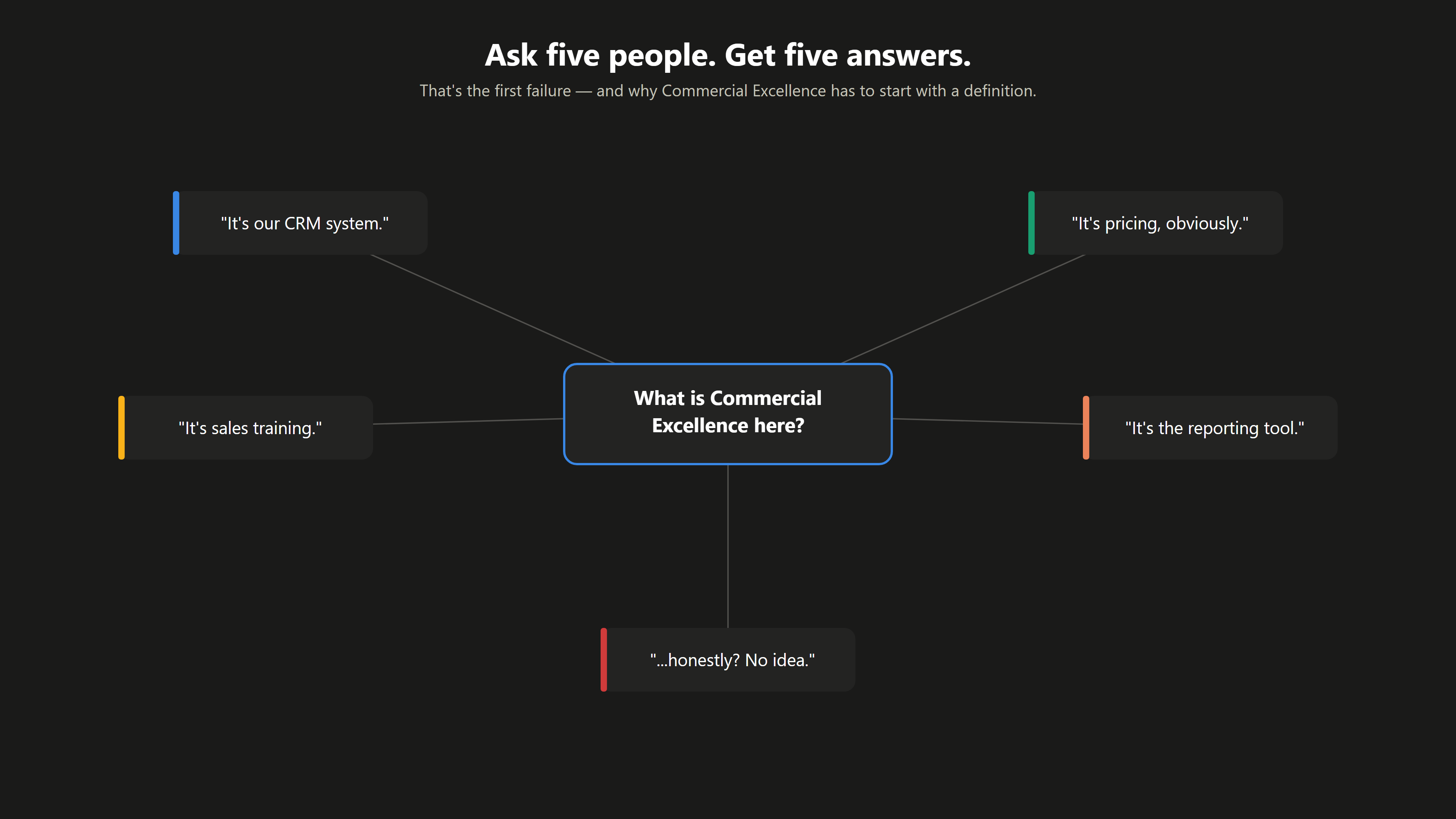
If people don’t understand what Commercial Excellence is, they can’t understand why it exists. Everybody seems to have a different definition. So instead of debating terminology, here is the definition I use.
Model 1The Builder Method: Understand → Model → Leverage → Build
To me, Commercial Excellence is the discipline of understanding commercial systems, turning them into models, identifying leverage, and building better ways of working.
Notice what isn’t in that definition. No CRM. No pricing. No reporting. No department. Commercial Excellence isn’t defined by the tools it uses. It’s defined by the systems it builds.
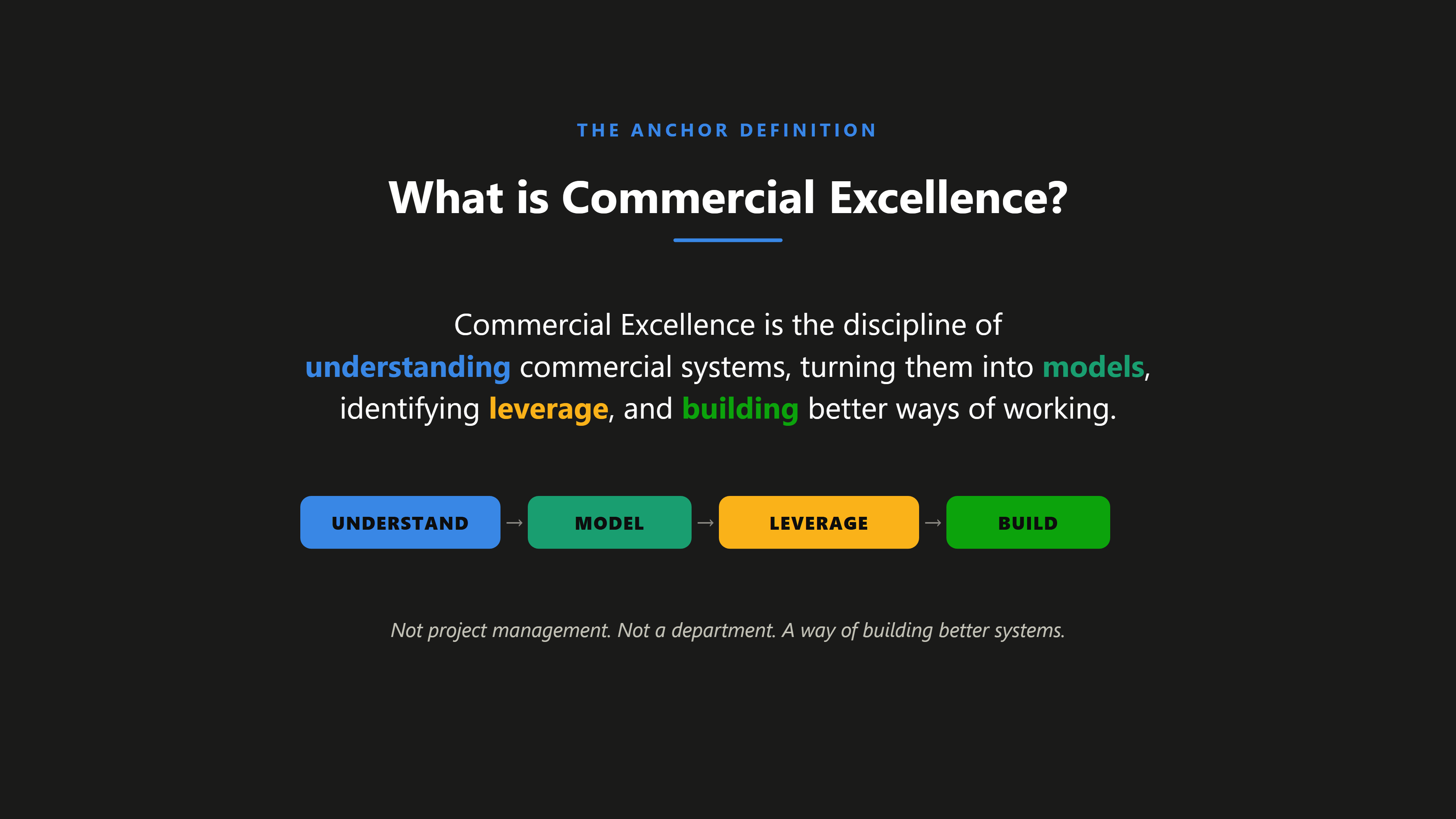
Every Commercial Excellence initiative I’ve ever worked on follows the same four steps. First, understand the existing system. Then turn it into a model. Once you have a model, you can identify the leverage. And only then you build a better system. This is the method I use whenever I try to improve any system.
AI doesn’t replace any of these four steps. It accelerates every single one of them. It helps us understand faster, model faster, identify leverage faster, and ultimately build better systems faster.
Solutions before understanding
If you’ve ever worked in Commercial Excellence, you’ve probably seen this before. A big roadmap, hundreds of ideas and projects. A new CRM is needed. The pricing approach must be reworked. Customer segmentation must be implemented. Years later, with a lot of money invested in software, consultants, time and effort, nothing really changed.
Why is that? Many Commercial Excellence projects start with solutions before they’ve understood how the commercial system actually works.
You can’t improve what you don’t understand.
The biggest commercial decisions are often made before anyone has actually observed the process. Someone who isn’t part of the system has already decided what the problem is.
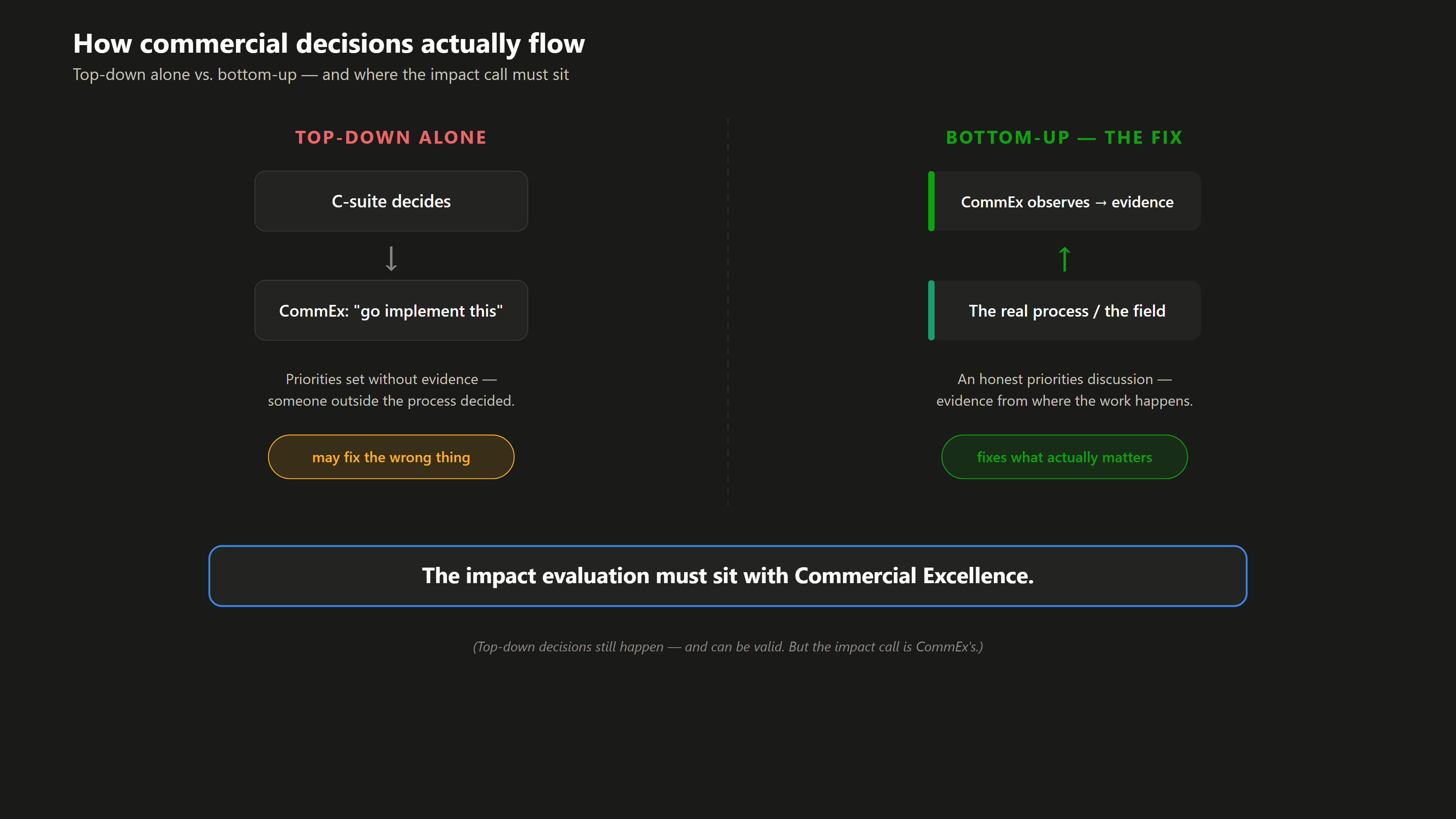
To be fair, sometimes those decisions are absolutely justified. Your CRM vendor ends support. Your company acquires another business. Regulations change. Commercial Excellence isn’t there to block those decisions. Our job is to understand their impact and to challenge the assumptions behind them.
If you’re not doing that, you have very little chance of fixing a problem, but a big likelihood of verschlimmbessern the status quo. Verschlimmbessern is a German word. Literally it means to worsen-improve: making something worse while trying to improve it.
Model 2The leverage map
So how do we avoid making the same mistakes again? We understand the system, and we do that by building a model.
Understanding systems is difficult. There is an unlimited number of unknowns, which lead to uncertainty, and it is our job to reduce uncertainties. The main job of decision-makers is to reduce risk. So good luck explaining a complicated system with an unlimited number of unknowns. That’s why the second step isn’t yet a meeting and not yet the big alignment. It’s the model that explains the system in a very simple way. Models turn complexity into something people can actually discuss.
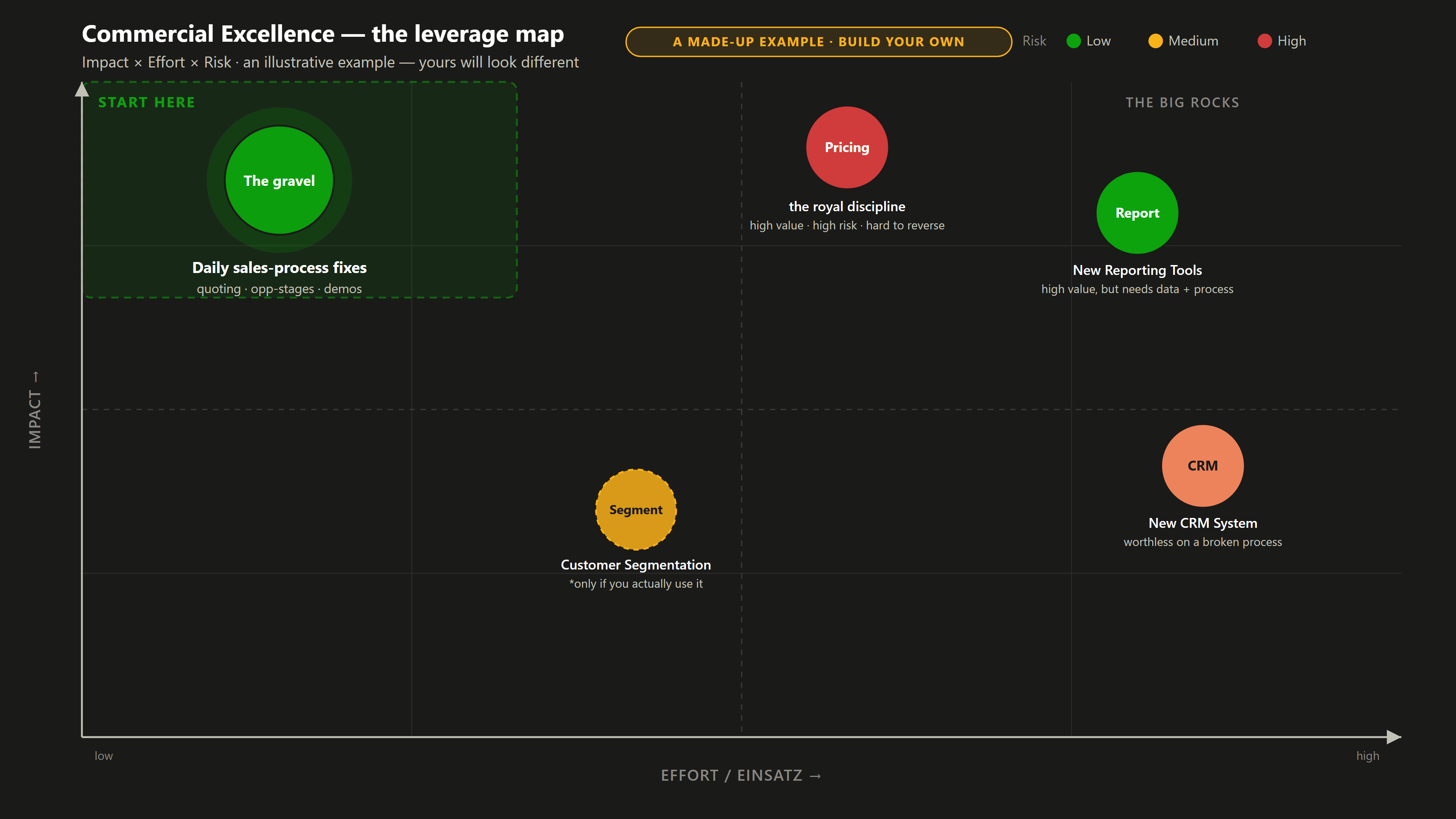
This is my example model. I didn’t make it to be copied. I made it to show what modelling a system actually looks like, not what yours should contain. It has three dimensions: impact, effort, and risk or reversibility. Identify your big rocks, identify your small rocks, and assess them. Not all big rocks create big impact.
Pricing against the small improvements
Take pricing first. It creates a significant impact. It also creates a significant commercial risk, and then consider the effort. You don’t implement a new pricing approach overnight.
Now the small improvements. They outperform the big projects on almost every dimension. They’re cheaper, less risky and easier to reverse, and they create the foundation the big projects depend on.
Most companies try to start with transformation. I prefer to start with momentum.
Don’t copy my model. Build your own. Every company has a different commercial system, and different systems require different models. But take a very close look at your process improvements. I can almost guarantee you that’s where you find the momentum.
A score on a slide is still a guess
Once you have a model, the conversation changes. People stop arguing about opinions and start talking about leverage. There’s something deeper here. When you build the model, you frame the discussion. You don’t just describe reality, you shape it.
The map gives you your best guesses about where the leverage is. But a score on a slide is still a guess. The real work, and today the cheap part, is checking it: does this process actually have the upside we assumed? Sometimes yes. Sometimes you find less than you hoped, and you move on. The map tells you where to look first. Observation tells you what’s really there.
Where the work actually happens
Based on the map, the logical next step is to get our hands dirty and earn some acceptance. Talk to people. Do work shadowing. Understand the processes. Sit with Customer Care, with Service, with Order Processing. And take a good look at the interfaces nobody can explain.
Sitting next to the people who actually do the work. That’s where Commercial Excellence actually happens.
If you haven’t observed the process yourself, you don’t have an informed opinion. You have a hypothesis.
Dashboards show outcomes. Processes explain outcomes.
What AI changes
Process improvement isn’t a pricing project, but it’s still connected to significant effort. In the past, understanding a commercial process was the expensive part. Before you could improve anything, you needed interviews, workshops, consultants and process maps. Weeks, months, even years of work. Understanding came first, but understanding was expensive.
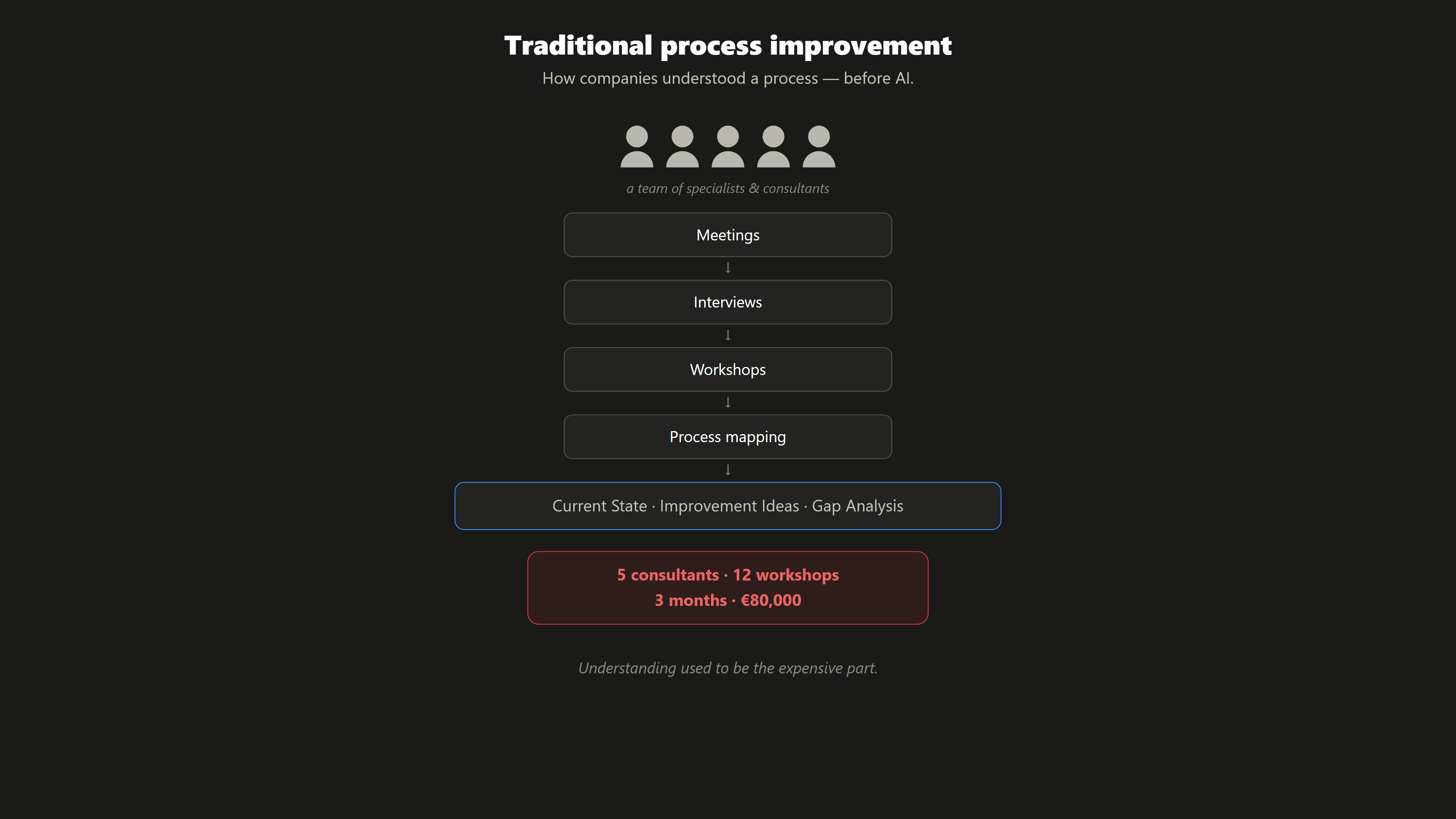
What happens now is that you simply record a process while shadowing it. You use your screen recording, and you have it analysed with the help of AI. All you need is one person who knows the process, and the screen recording.
AI can analyse and map your current process in almost any format you like, and even propose a future process with the required improvements. The gap analysis is almost a side effect, and it builds your business case.
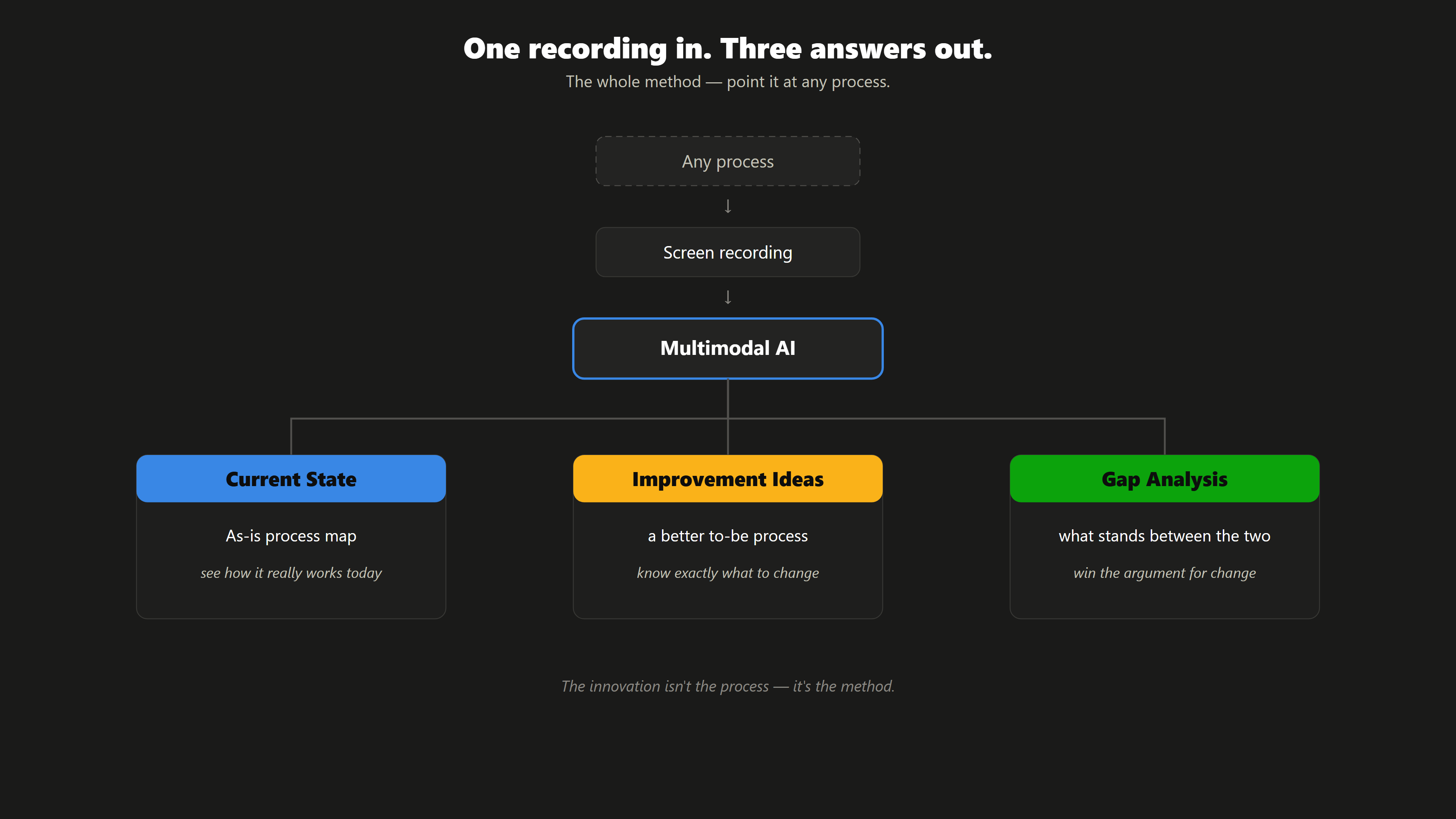
Now notice something interesting. The process itself doesn’t matter. It could be quoting, Customer Care, order entry, CRM or onboarding. The process is interchangeable.
The innovation is not the process. The innovation is the method.
What genuinely excites me isn’t AI itself. It’s what AI removes. It removes dependencies: waiting for consultants, waiting for workshops, waiting for budgets, waiting for permission.
Builders have always known what they wanted to improve. The problem was never the idea. The problem was the cost of understanding. AI changes exactly that.
Five things to keep in mind
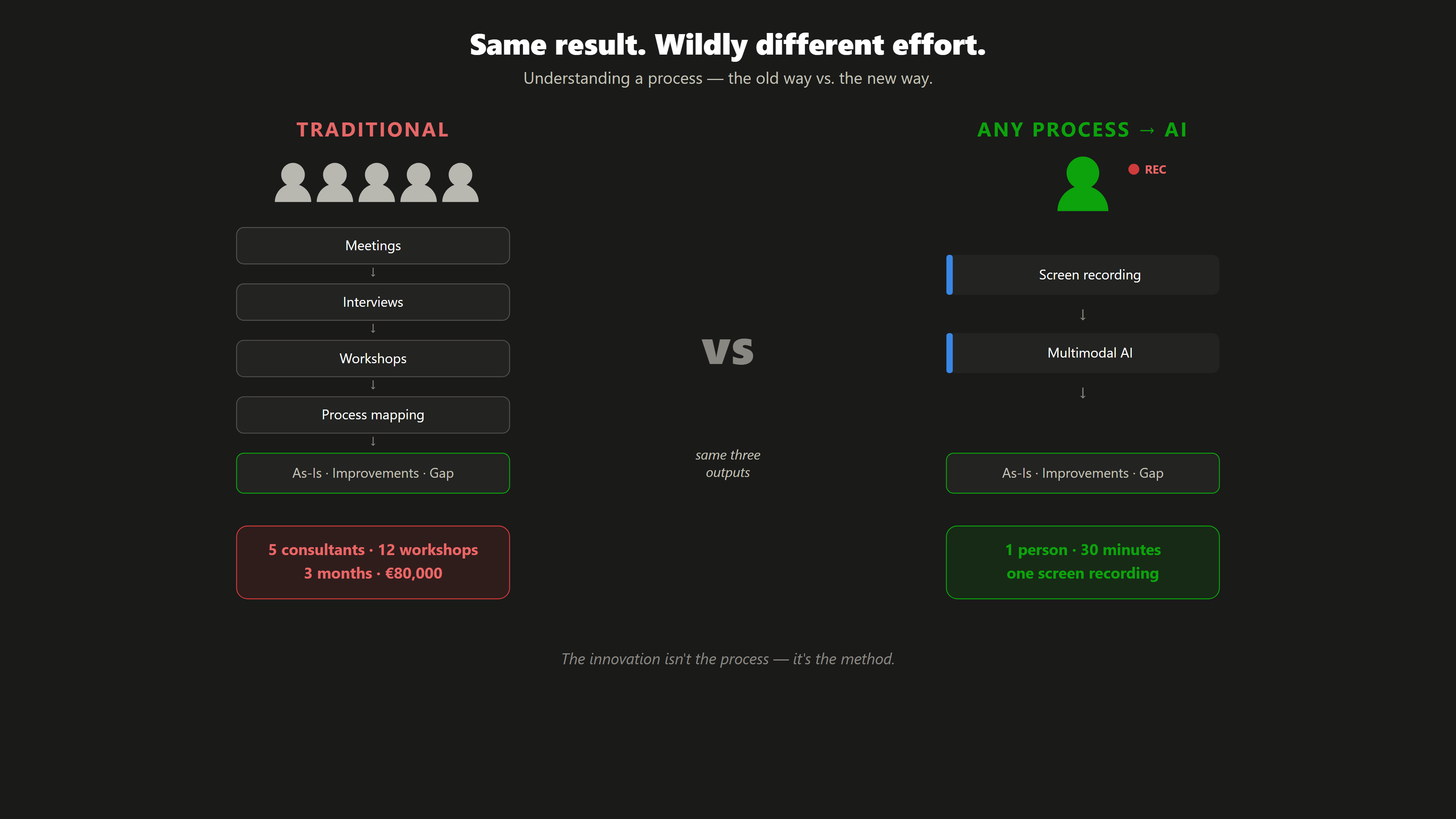
Drop the outdated approach and embrace the new possibilities with AI. A few disclaimers belong with that.
- AI creates the first draft.
- Humans validate the process.
- No customer data and no confidential data.
- No blind trust. Always challenge, and think critically.
- AI accelerates thinking. It doesn’t replace it.
Commercial Excellence isn’t changing because AI provides better answers. It’s changing because AI changes the economics of understanding.
If understanding becomes dramatically cheaper, building better commercial systems suddenly becomes possible at a completely different scale.
The German word of this episode
Verschlimmbessern “to worsen-improve”
Making something worse while trying to make it better.
Terms on this page
- Commercial Excellence
- The discipline of understanding commercial systems, turning them into models, identifying leverage, and building better ways of working.
- Builder Method
- Four steps for improving any system: understand the existing system, turn it into a model, identify the leverage, and only then build a better system.
- Leverage map
- An example model that assesses possible improvements by impact, effort and risk or reversibility. It tells you where to look first.
- Big rocks and small rocks
- Big rocks are the large projects such as pricing or a new CRM. Small rocks are the small process improvements that are cheaper, less risky and easier to reverse.
- Verschlimmbessern
- A German word for making something worse while trying to improve it.
- Cost of understanding
- The effort it takes to understand a commercial process before you can improve it. It used to be the expensive part, and it is what AI changes.