

The short answer
Most companies don't have a lead problem. They have an understanding problem. People believe they share the same understanding when they actually don't.
A lead is one box for many different intentions, and one standardized process has to serve all of them. Create shared understanding first, then design the process. Document the understanding, not just the process.
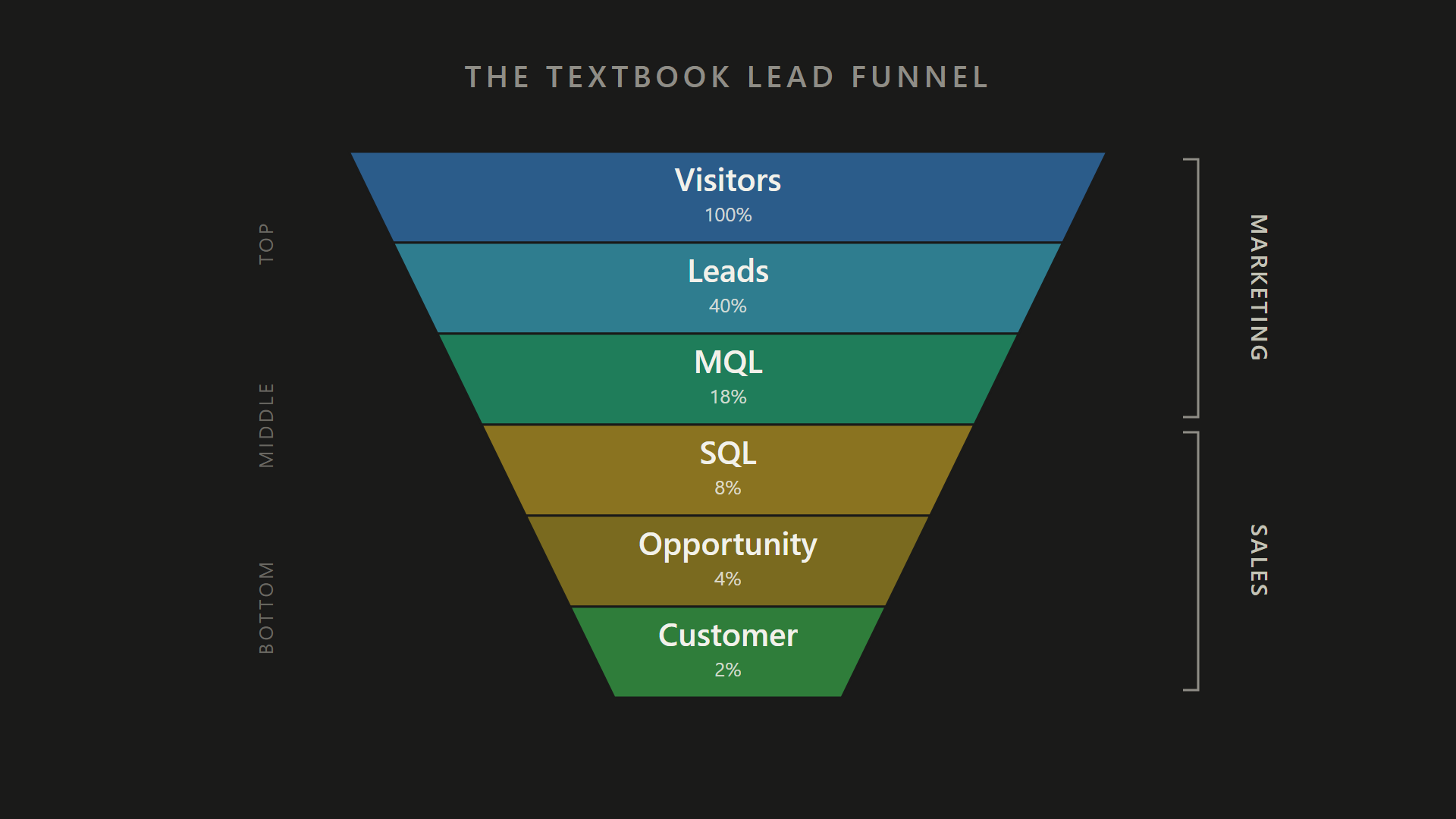
Almost every company knows this funnel, and almost every company keeps rebuilding its lead process. The CRM rollout failed. Lead scoring failed. Marketing blames sales, sales blames marketing. In the end, nobody is happy.
I don’t think the process is the problem. I think we’re trying to optimize something that doesn’t actually exist.
The biggest inefficiency in most companies isn’t the process. It’s that people believe they share the same understanding when they actually don’t.
Shared terminology is not shared understanding.
Model 1Impact against clarity
Before we improve anything, let’s first understand the system. The aim is not to optimize leads. It is to see where one standardized process hides too much complexity.
So look at the main ways a customer actually enters a business: the company website, a webinar, a trade fair, external portals, distributors, existing customers, referrals, outbound. They differ in three things: how much volume they bring, how much business impact they carry, and how clear the customer’s intent is. Plot impact against clarity.
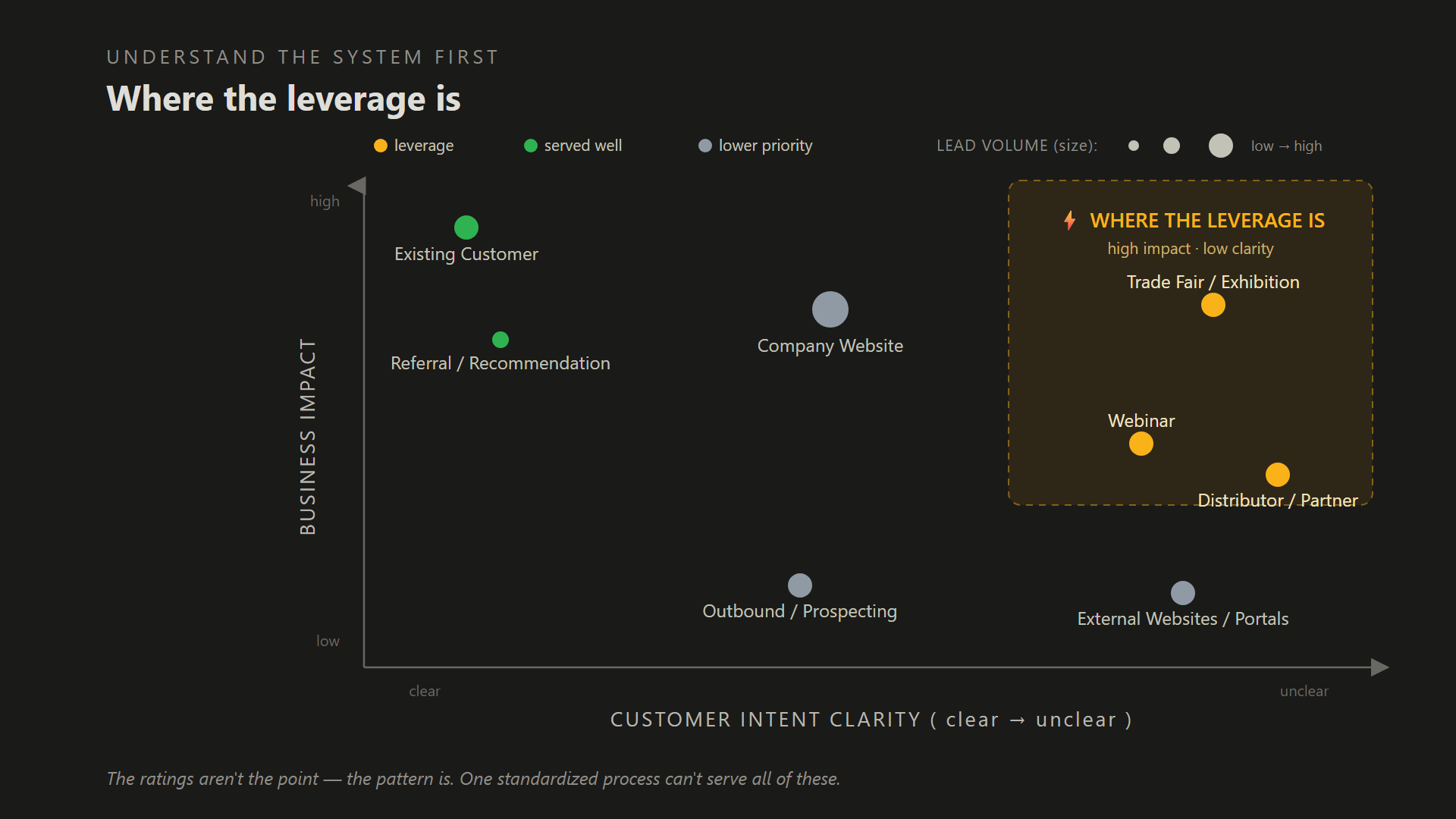
The exact ratings don’t matter. These entry points are fundamentally different, so one standardized process performs poorly. This is not a criticism of CRM systems. It is a criticism of oversimplification.
The pattern I watch for is high business impact plus low clarity. That’s where I get suspicious.
Webinar leads: wrong expectations of each other
From experience, the process for webinar leads is only a slight variation of the standard. The break is not the webinar lead itself. It is that everyone in the process has wrong expectations of each other.
Marketing thinks inside sales calls everyone. Inside sales thinks marketing has pre-qualified. Sales expects finished opportunities. Nobody ever aligned on who actually does what.
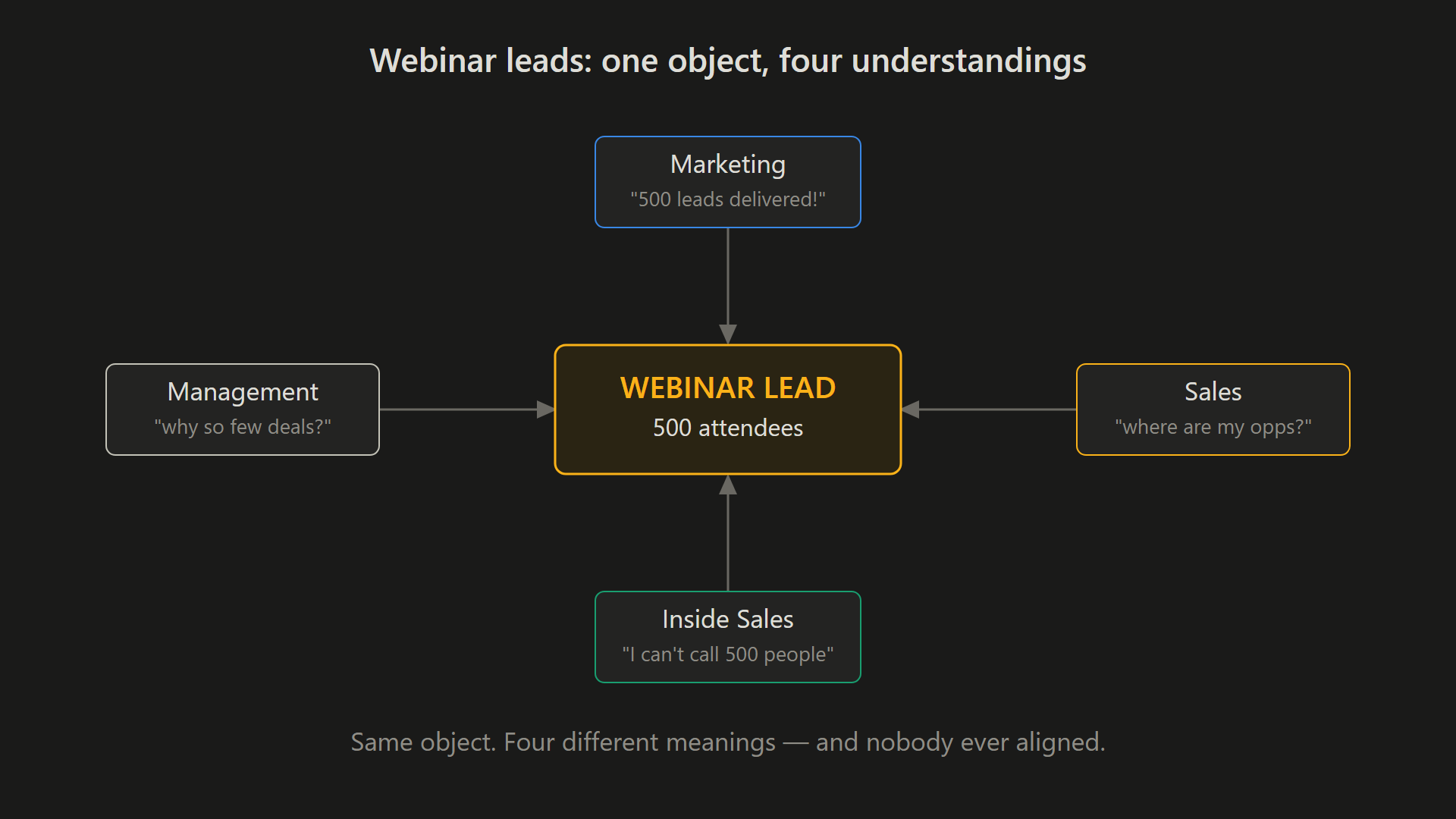
Nobody was wrong. Everyone simply had a different understanding of what the others were doing.
The fix is almost boring: exchange and transparency. Put everyone at one table and let them say out loud what they expect from each other. That’s it.
Scheinkonsens
One German word fits here: Scheinkonsens. Illusory consensus. Everyone agrees on the word, no one agrees on the meaning.
Trade-fair leads: same label, different value
That celebrated trade-fair lead can be exactly as worthless as a newsletter lead, if the definitions and rules aren’t cleanly applied.
It varies on two axes at once. First, the visitor: someone strolling past, pushed by staff into handing over a contact, versus someone who walked up on purpose. Second, who collected it: your own staff, who score strictly, versus an external partner or distributor who is rewarded for volume. Same label. Wildly different value.
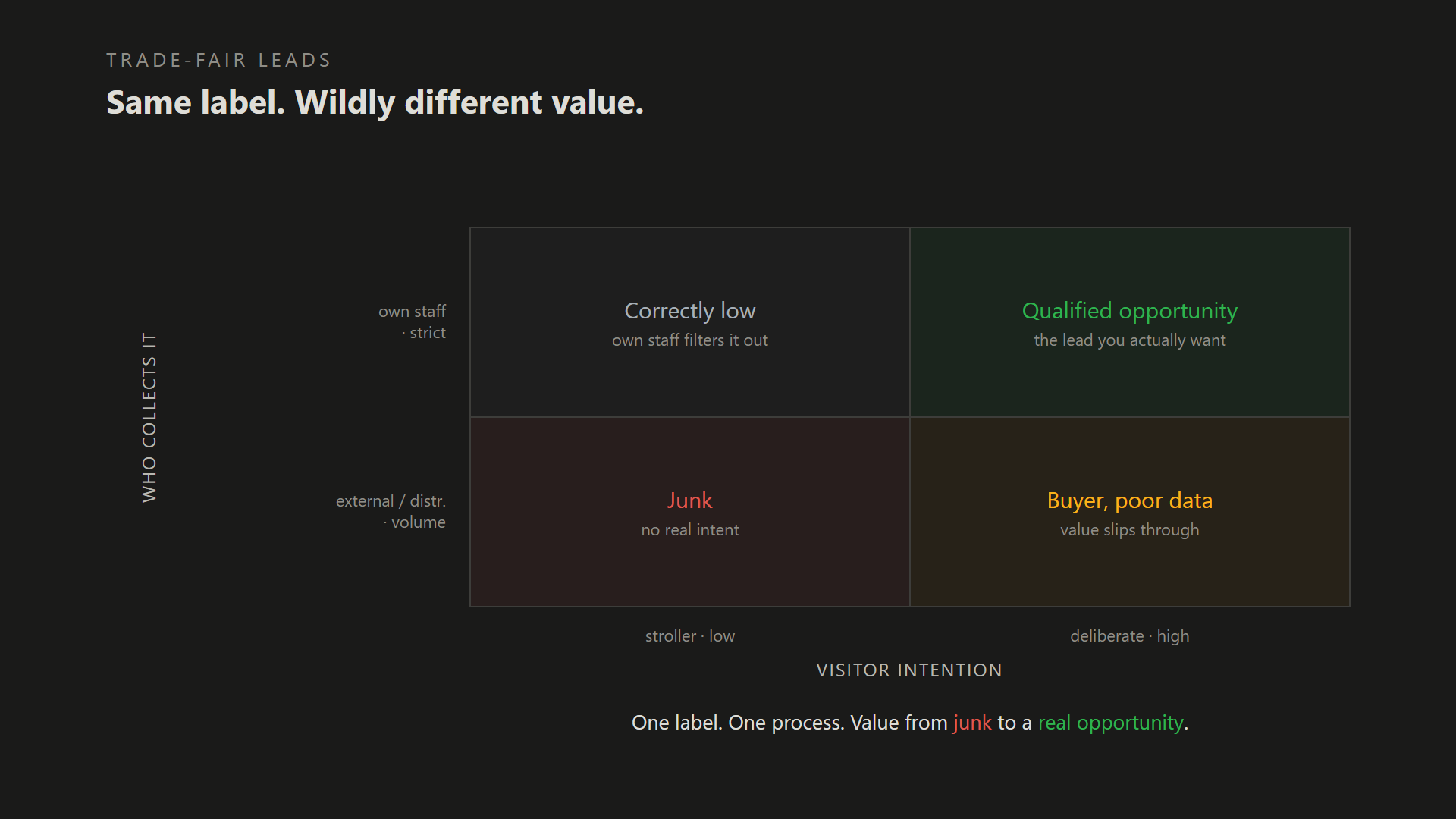
The fix is the same again: documentation, transparency, alignment. Not a better CRM, but clear, shared definitions.
There is no such thing as a lead. Only different intentions, arriving through different doors.
A lot of complexity has been simplified by experts into one universal process. The tradeoff is leads falling out of the funnel left and right. We are trying to further optimize an overoptimized system.
The workshop
When I walk into a company, I never start by redrawing the process. I bring all the parties into one room: marketing, sales, inside sales, customer care, sometimes the distributors. We walk the process together. Who does what, and when?
Then we document it together. You can even let an AI listen in and help. The output isn’t a fancy BPMN. It is a process everyone can follow and, most importantly, one that is written down.
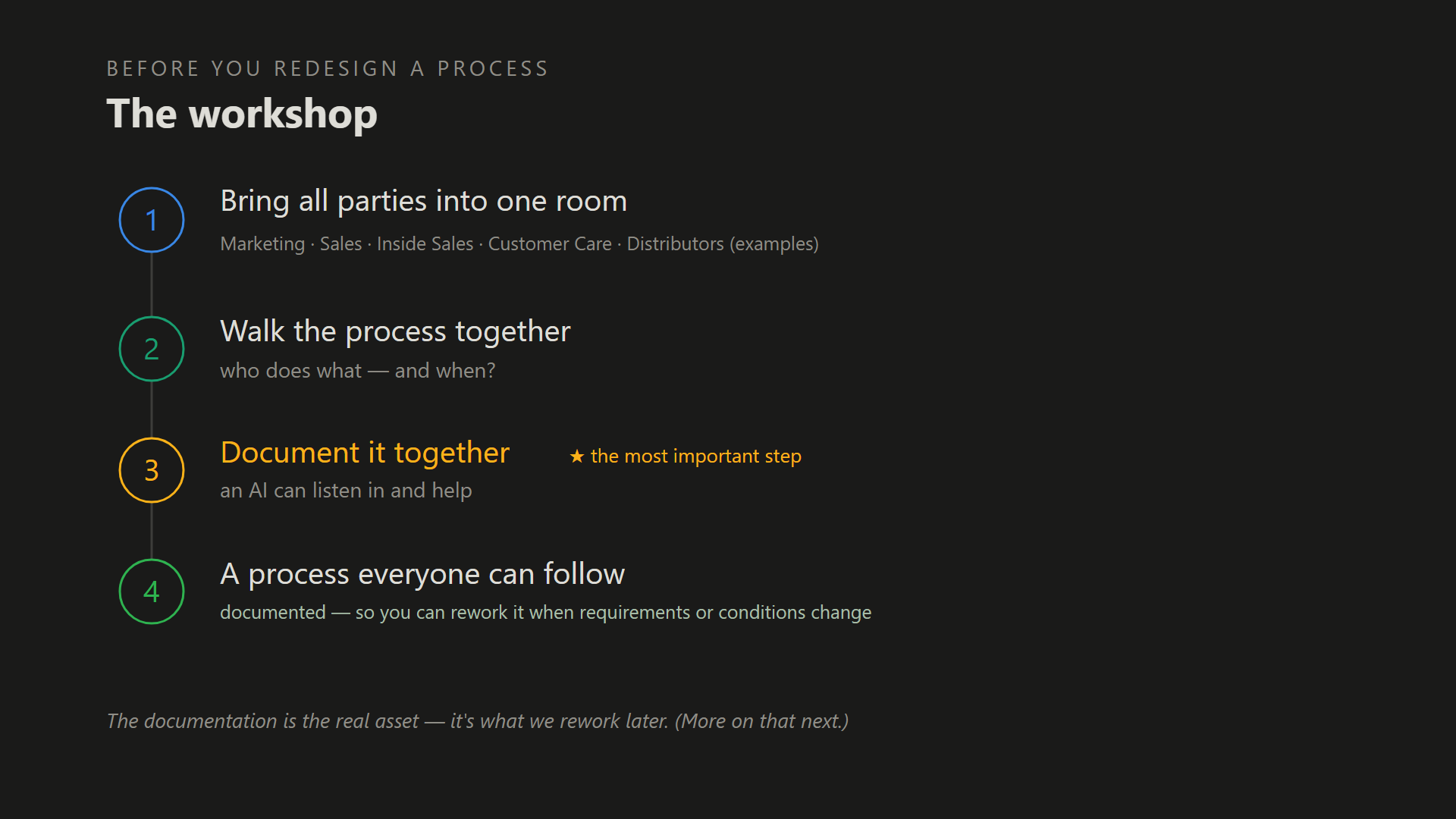
The documentation is the real asset. That is what we rework later, when the requirements or conditions change. People enjoy it, too. They designed it, so they carry it.
Model 2Problem → Requirements → Process
Most companies jump straight from the problem to a process, and then treat that process as the truth. But a process is only today’s answer, never the universal solution.
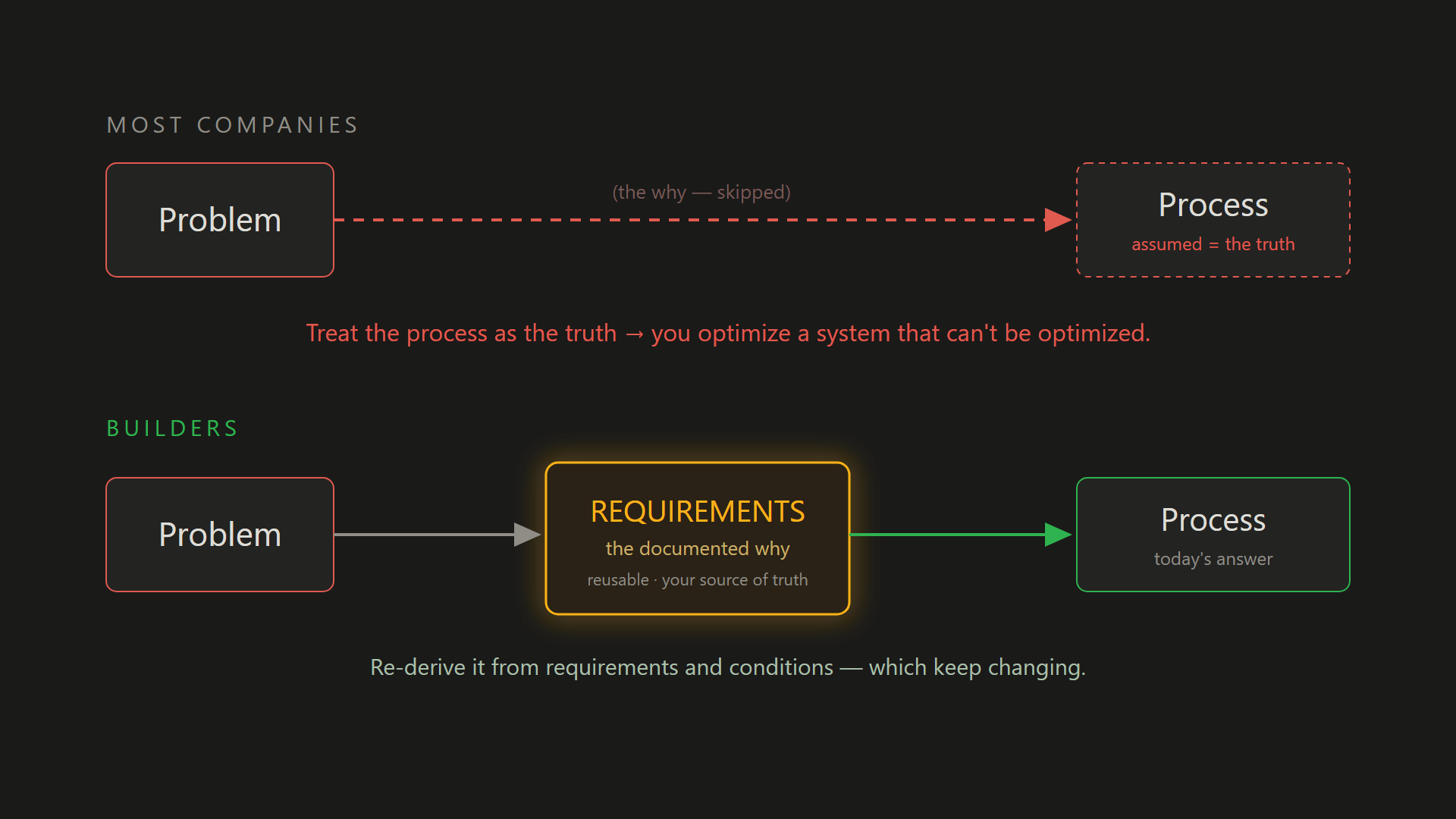
Builders document the why, the requirements, and re-derive the process whenever the requirements or conditions change. Treat the process as truth, and you optimize a system that can’t be optimized.
Processes are temporary
Most companies stop the moment the process is live. I’d add one more step: don’t just document the new process, document why you changed it.
Because processes change. Understanding doesn’t disappear that fast. When your business changes tomorrow, you won’t start from zero. You’ll build the next process from the same understanding.
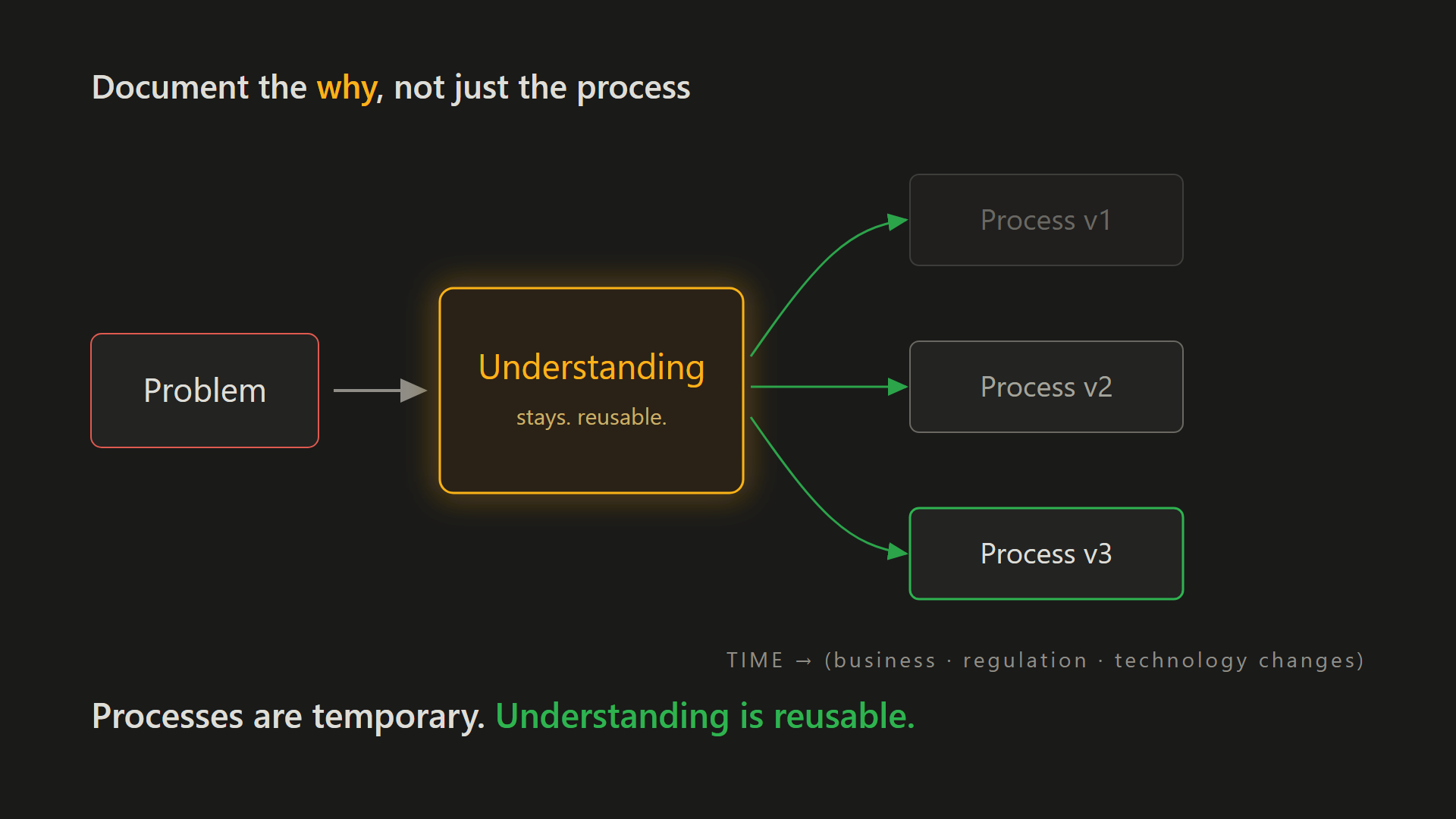
Processes are temporary. Understanding is reusable.
A lead is a variable
The lead exists because of a human limitation. No one could process every intention, so we built one box and called it a lead. Once you see that, something clicks.
A lead is just a placeholder. A variable. And you define it, however works best. These are all just variables. We fill them with meaning by defining them.
Three fields to write down
Creating a shared understanding is already valuable. But there is one more thing I’d document after the workshop, and it is not the process.
Most teams document the result: the workflow, the stages, the responsibilities, the BPMN. But the result will change. What you really want to preserve is the reasoning behind it. There is a full, formal way, with user stories in Jira and Confluence, but in operations I almost never see it done. So reduce it to three fields.
Three questions. What were we trying to achieve? Which constraints were true at the time? And which decision did we make because of them?
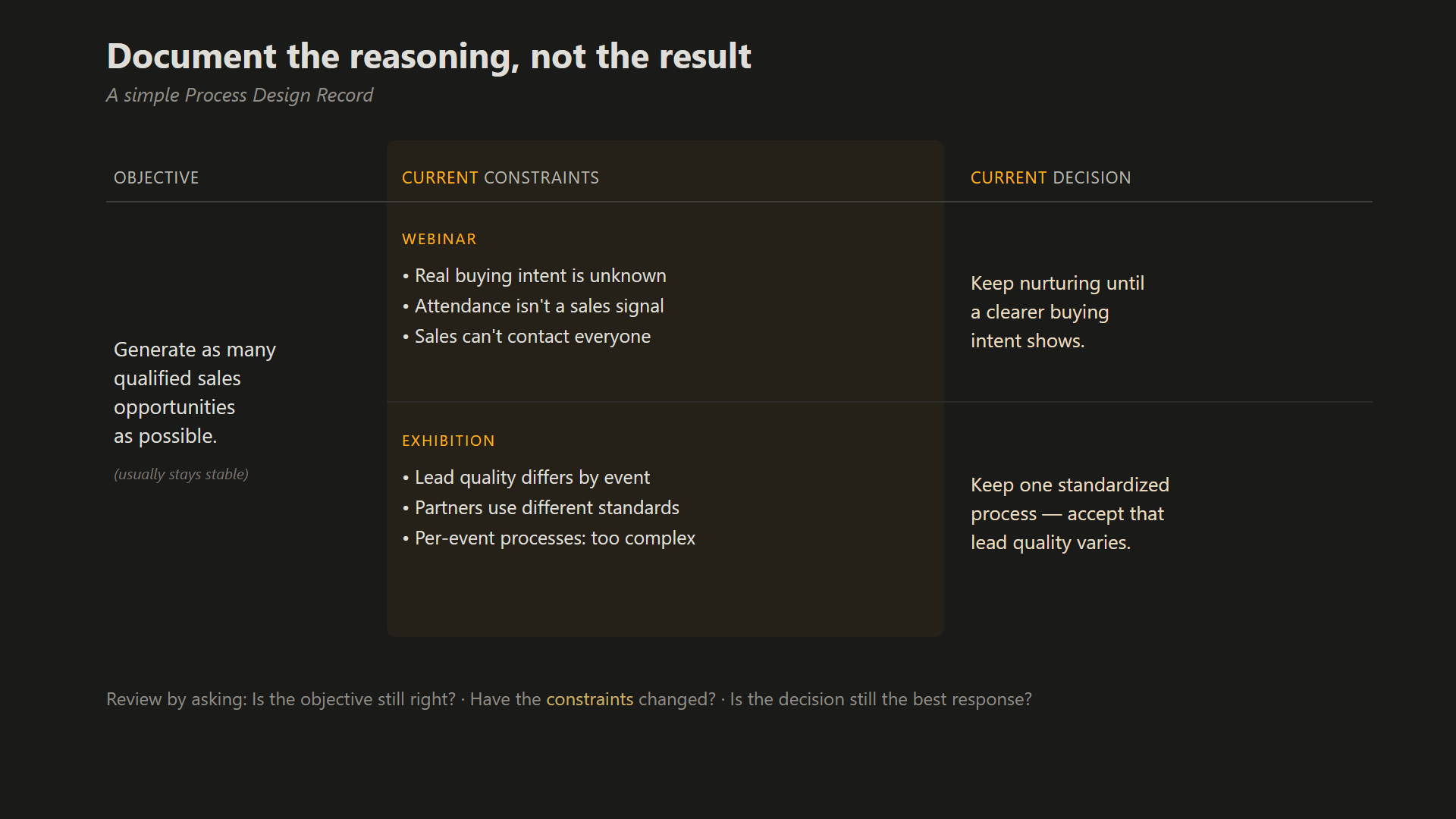
Take the webinar. The objective is as many qualified opportunities as possible. But we don’t know real intent, and sales can’t contact everyone. So we keep nurturing until intent becomes clearer.
That decision isn’t permanently correct. It’s correct under the current constraints.
A process isn’t wrong just because it’s imperfect. Running one standardized exhibition process, knowing that quality varies, can be perfectly rational if you currently can’t run one per event. It only becomes a problem when you document the process and forget why you accepted the limit.
So the process becomes reviewable through its reasoning. Whenever you revisit it, ask three things.
- Is the objective still right?
- Have the constraints changed?
- Is the decision still the best response?
The day a constraint changes, say capacity or AI now lets you qualify everyone, you don’t accept the old decision. You review it.
Don’t finish with a process diagram. Record the objective, the constraints, the decision. Document the reasoning, not the result.
The German word of this episode
Scheinkonsens “sham consensus”
Everyone agrees on the word. Nobody agrees on the meaning.
Terms on this page
- Lead
- A placeholder, a variable: one box built for many different customer intentions, which means what you define it to mean.
- Entry point
- A way a customer enters a business, such as the company website, a webinar, a trade fair, a distributor or a referral.
- Scheinkonsens
- German for illusory consensus: everyone agrees on the word, no one agrees on the meaning.
- Requirements
- The documented why behind a process, from which the process is derived again whenever requirements or conditions change.
- Process Design Record
- Three fields written down after a process workshop: the objective, the constraints that were true at the time, and the decision made because of them.