


The short answer
A price list is one of the greatest management simplifications ever created. But it is the result of a pricing strategy, not the strategy itself.
If you only manage the list and forget why the prices exist, you are no longer managing your pricing strategy. You are managing historical decisions. The fix is to document the reasoning, not the prices.
During my master’s degree, we had just one hour of pricing each week. At the same time, we spent multiple hours on statistics, marketing and many other subjects. I still remember the professor pointing out how strange that was. Pricing is probably one of the biggest levers a company has. It can make or break a business. Yet it receives surprisingly little attention.
That thought has stayed with me ever since. So here is the question: do you actually have a pricing strategy, or are you just managing your price lists?
There are two fundamentals every pricing strategy needs, and I am deliberately not covering either of them here. The first is contribution margin, at a minimum by product and by sales channel. Otherwise you cannot answer where you are actually making money. The second is the textbook price calculation, which is honestly not the difficult part of pricing.
Model 1The Pricing Triangle
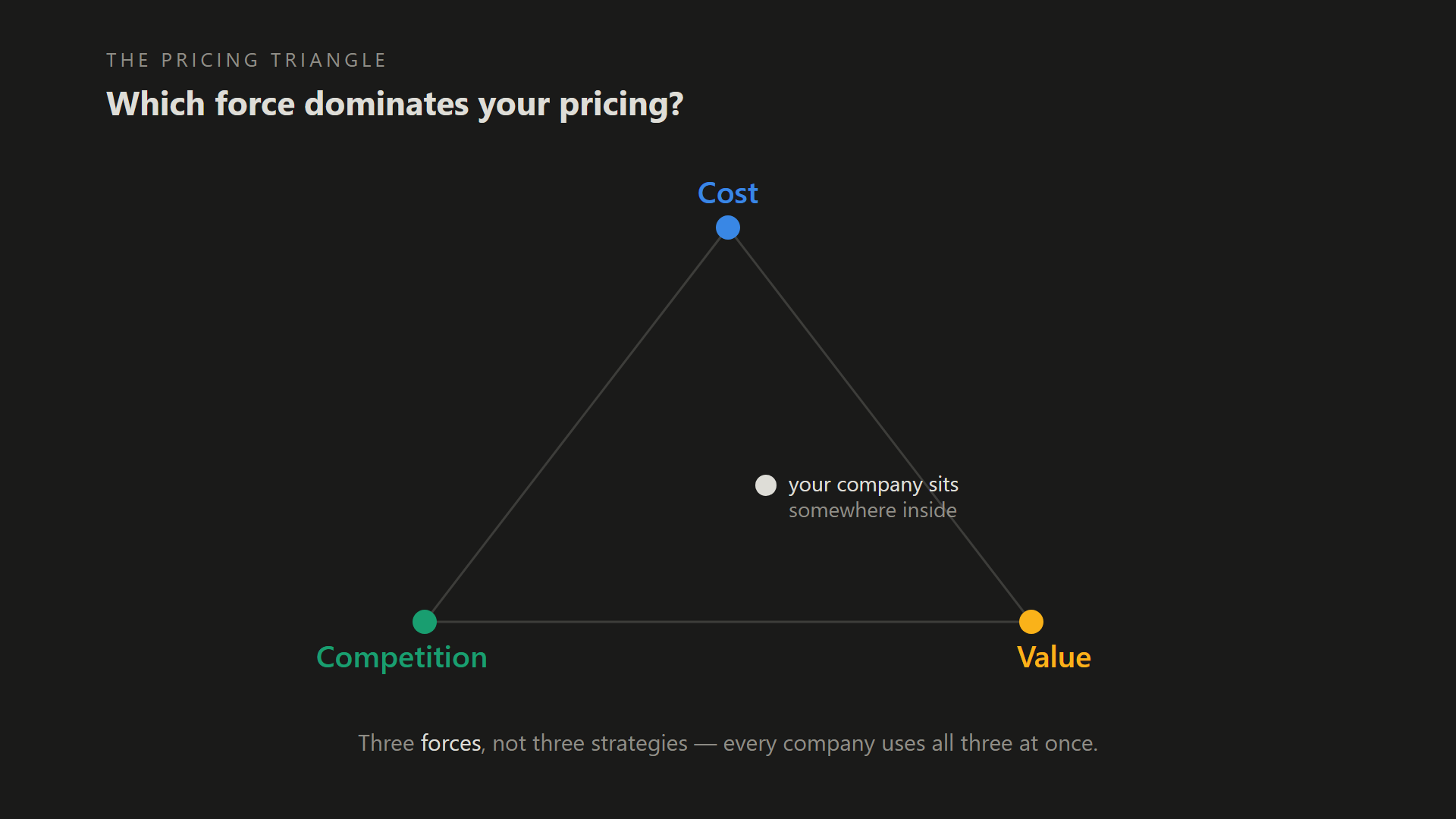
Most business schools teach three pricing strategies as if you had to choose one: cost-based, competition-based and value-based. That is not how real companies work. Every company uses all three.
The real question has never been which pricing strategy you have. It is which of these three forces dominates your decisions. They are not categories. They are forces, and every company sits somewhere inside this triangle.
Model 2The Pricing Profile Canvas
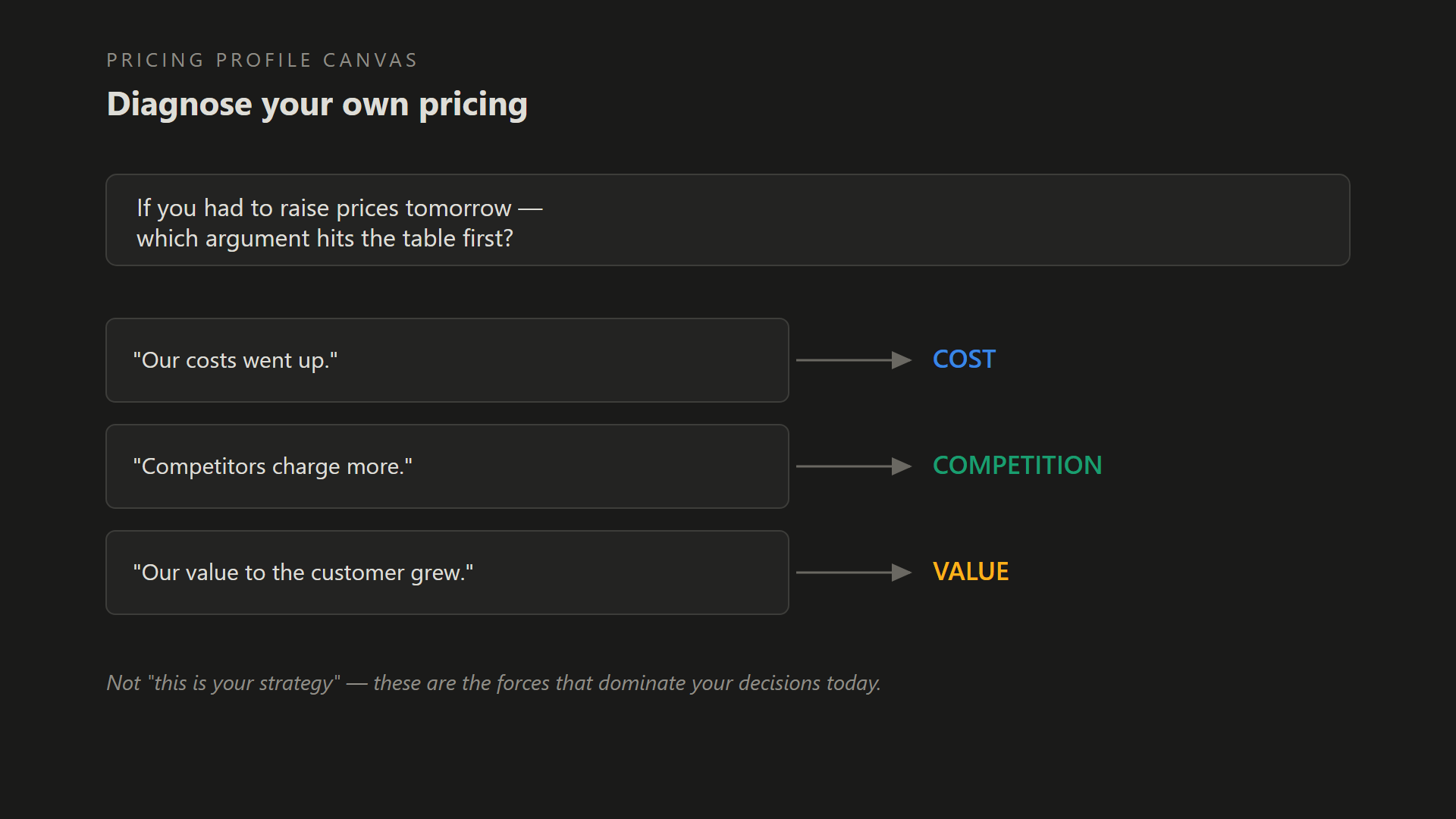
The obvious next question is which force dominates your pricing. Most companies have an answer. Very few have a way to verify it. So let’s not guess. Let’s diagnose it. The canvas is not a test. It is a mirror. It shows the forces that actually drive your pricing decisions today.
Here is how it works, with one decision. Imagine you had to raise prices tomorrow. What is the first argument you hear in the meeting? “Our costs went up” is a vote for Cost. “Our competitors are already charging more” is a vote for Competition. “We deliver more value today” is a vote for Value. One answer is enough to reveal a reflex.
Four decisions, four votes
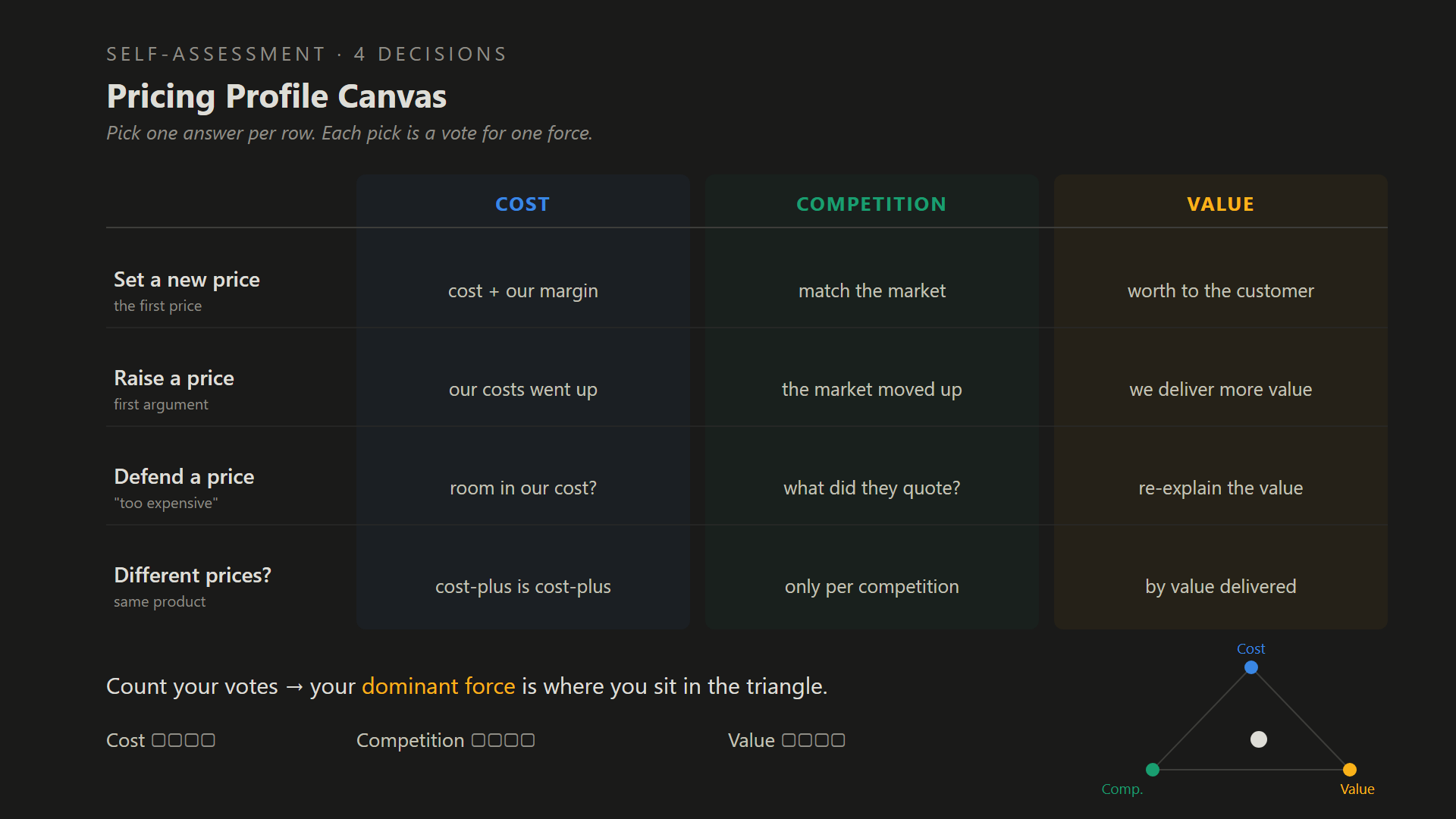
Now do it properly, across four real pricing decisions. Don’t overthink it. Pick the answer that feels most natural. Your first instinct reveals your default.
- Setting a new price. You launch a new product. How do you decide on the first price? Cost plus margin, comparable products, or customer value?
- Raising a price. It is time for your annual price review. What is the first argument in the meeting? “Our costs went up”, “The market has moved up”, or “We deliver more value than before”?
- Defending a price. A customer says: “You’re too expensive.” What is your immediate reaction? “Let’s see how much room our costs give us”, “Let’s find out what the competitor quoted”, or “Let’s explain the value we’re creating”?
- Different prices. Should two customers ever pay different prices for exactly the same product? “No. Cost-plus is cost-plus.” “Only if the competitive situation is different.” Or: “Yes. If the value is different, the price should be different too.”
In every row, the answers are votes for Cost, Competition and Value, in that order.
Question three is where theory meets reality. Pressure reveals defaults. If I’m honest, my own first reaction is usually to ask what the competitor quoted. Not because I want to copy their price. Because I want more information. But even that tells me something. My first instinct is still driven by competition.
Question four is about consistency. Almost every company claims to practice value-based pricing. But if your customers, industries or markets are all paying the same price, you are probably not pricing on value. You are pricing on cost or competition, with a value story on top.
Now count your votes. Whatever the result, that is your position inside the triangle. Not where you would like to be. Where your decisions actually place you.
Your pricing strategy isn’t defined by the PowerPoint your company presents. It’s defined by the decisions your people make every single day.
The gap
Here is what happens every single time I do this exercise with a team. I ask them one simple question: how do you price? Almost everyone answers: value. Then we work through the four questions, and the votes tell a different story.
People are rarely surprised by the result. They are surprised by the gap. The gap between the company they wanted to become and the company their daily decisions have actually created.
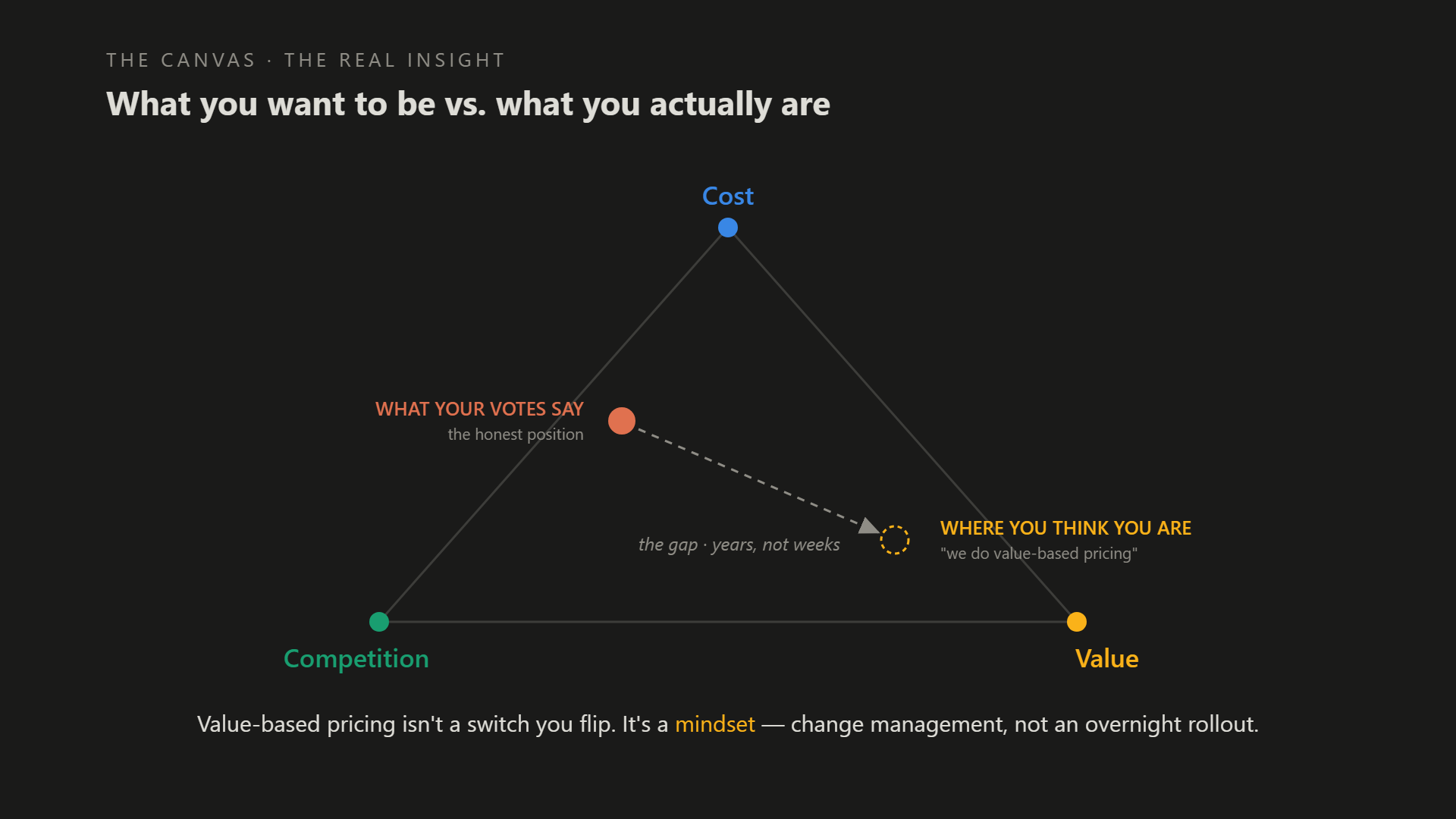
Closing that gap is the part nobody warns you about. Moving toward value-based pricing is not something you roll out on Monday morning. It is a mindset shift. It changes how Sales argues, how Marketing positions products, how Product creates value and how Finance measures success.
Value-based pricing isn’t a switch. It’s organisational change. Years, not weeks.
So if your votes landed on Cost, don’t feel bad. Most companies do. The exercise was never about judging the result. It was about making the gap visible. You cannot close a gap you cannot see.
Model 3The pricing hierarchy
How does a company end up acting past its own strategy in the first place? Here is the entire mechanism in one picture.
A price sits on a price list. The list came from a calculation. The calculation rested on assumptions. And the assumptions came from a strategy. But companies maintain the top layer, the prices. Not the bottom one, the strategy.
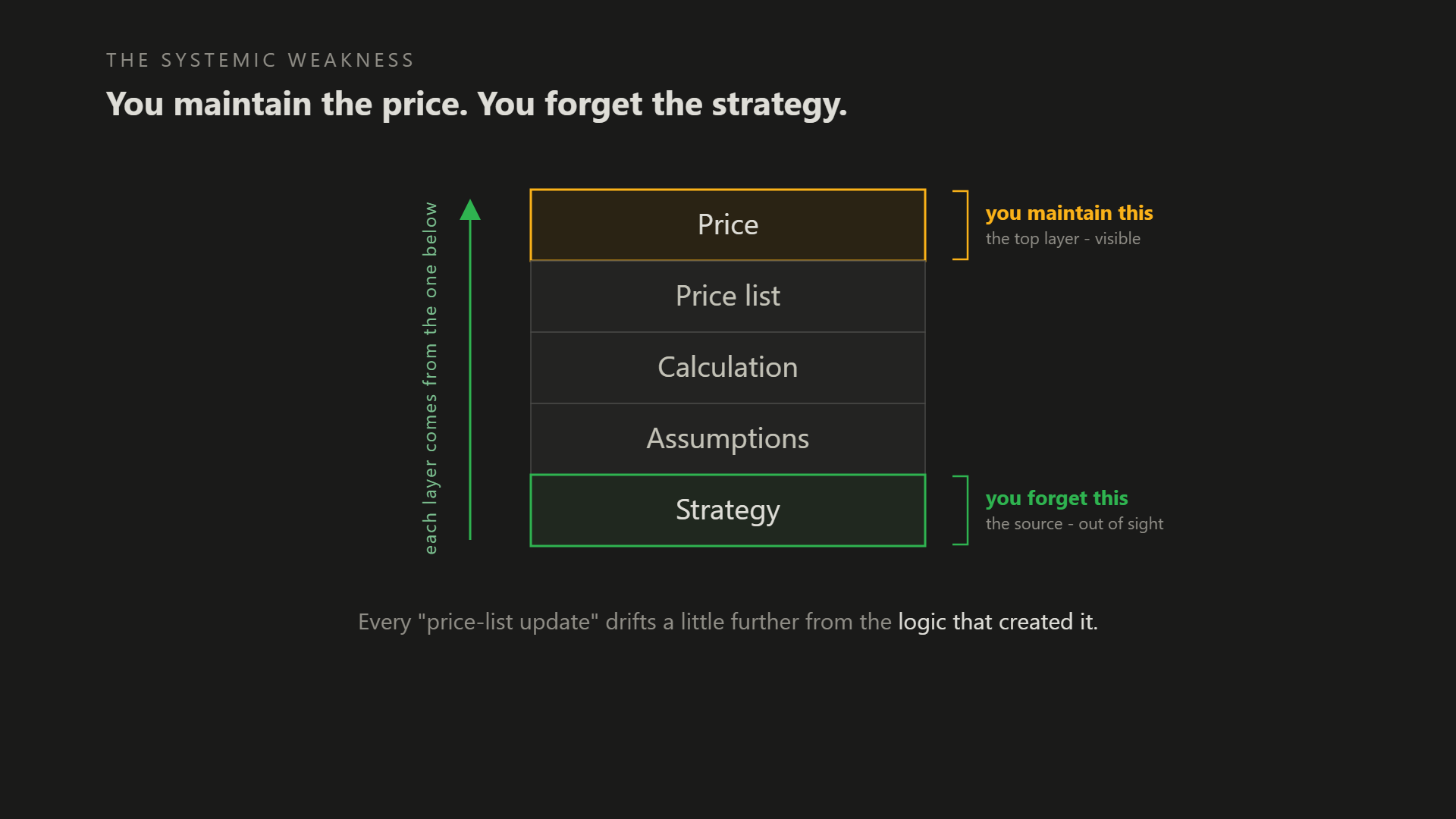
So every time you ‘update the price list,’ you drift a little further from the logic that created it.
This is bigger than pricing. Every management system is built under a specific set of assumptions. Then people maintain the operational result, here the prices and the price list, and quietly forget the assumptions that created it. Pricing is just the clearest example of a pattern that is everywhere.
The watering can
Here is what that drift looks like in real life. Over the years your prices became different, each for a reason. This one low to win a segment, that one high because the value really was higher. But nobody wrote the reasons down. Time passes. The people who knew them move on. And one day, in a budget meeting, someone says: “Let’s just raise everything by three percent.”
That is the watering can, in German das Gießkannenprinzip: the same treatment poured evenly over everyone, regardless of need. The price list survives. The strategy behind it has already disappeared.
That three percent feels harmless. It isn’t. It is the moment the last trace of strategy leaves your prices, and all you have left is a list you maintain.
What AI changes
Why did we ever compress pricing into a list in the first place? Not because a list was ideal. Because no human could continuously process every factor that should shape a price: cost, competition, region, purchasing power, customer value, lifetime value, portfolio effects. The price list was a simplification forced by a human limit. AI removes exactly that limit.
The future is not a better-maintained price list. It is a chain: strategy, to documented assumptions, to AI continuously challenging those assumptions, to continuously optimised pricing decisions. The question stops being “what does this product cost?” and becomes “what price is optimal for this customer, under today’s conditions?”
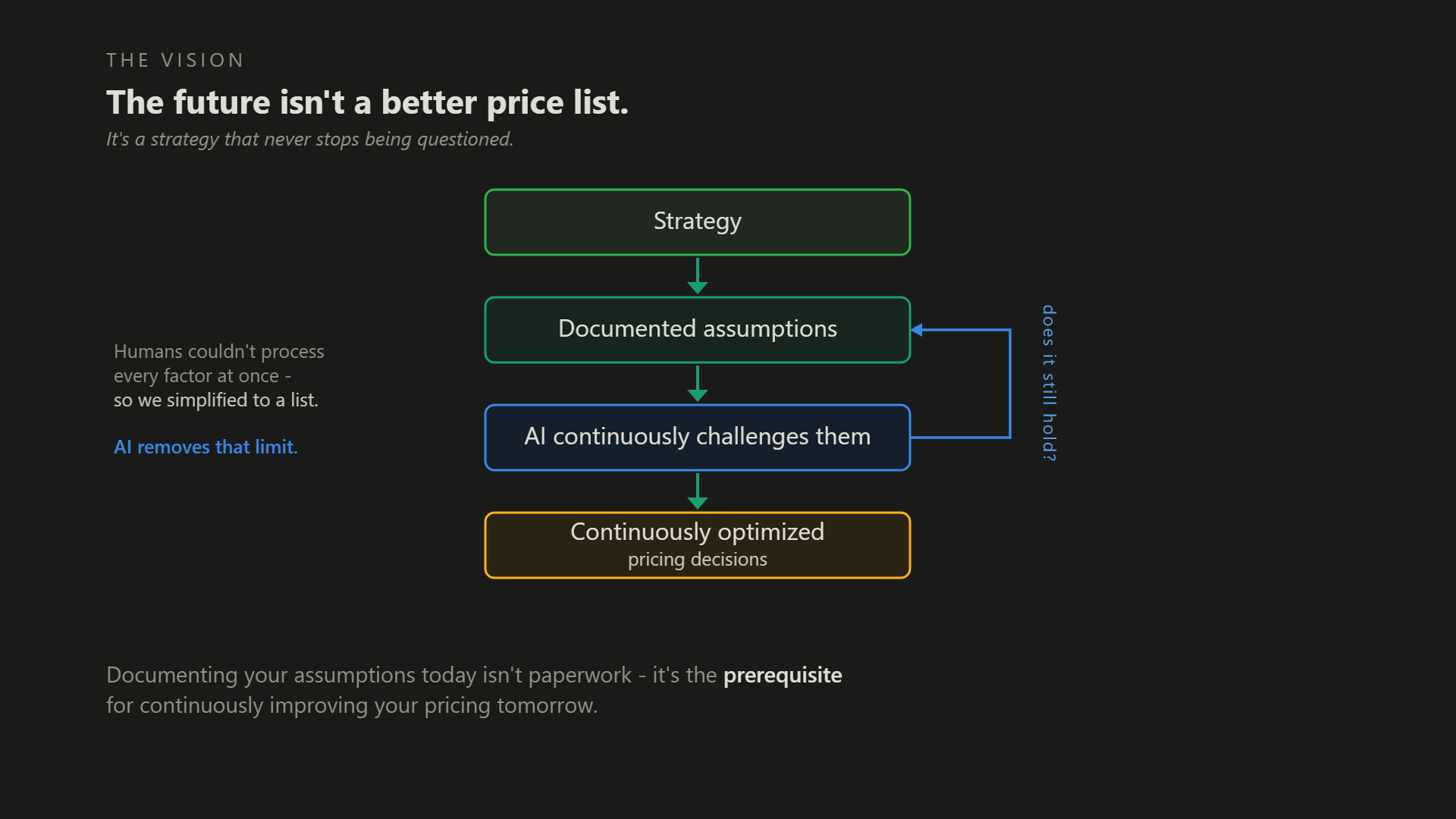
But AI can only work on what you have made transparent. So documenting your assumptions today is not paperwork. It is the prerequisite for continuously improving your pricing tomorrow.
Document why each price exists
So how do you stop the drift? There is exactly one move that matters, and it is not a fancier price list. Document the assumptions. Not just “what is the price?” but “why does this price exist?”:
- the segment it was meant to win
- the service revenue you expected
- the competitor you were undercutting
- the cross-sell it was protecting
The moment you write down why a price exists, you stop drifting. Every future change can now be checked against the reason that created it. A price with a documented reason can be challenged, defended or retired, on purpose.
A price without a documented reason can only be maintained, and slowly forgotten. Document the reasoning, not the prices.
Price lists are not bad. They were a brilliant management innovation. They let companies scale. The problem only begins when you manage the list instead of the strategy behind it. The real question is not whether you have a pricing strategy. It is whether your price lists still reflect it today.
The German word of this episode
Gießkannenprinzip “watering-can principle”
The same treatment poured evenly over everyone, regardless of need.
Terms on this page
- Pricing Triangle
- Cost, competition and value as three forces that act on every pricing decision at once. Every company sits somewhere inside the triangle.
- Pricing Profile Canvas
- A self-assessment across four pricing decisions in which each instinctive answer is a vote for cost, competition or value.
- Dominant force
- The pricing force your daily decisions naturally gravitate toward, which is not necessarily the strategy on the slide.
- Pricing hierarchy
- The stack of price, price list, calculation, assumptions and strategy, in which each layer comes from the one below.
- Gießkannenprinzip
- The watering-can principle: the same treatment poured evenly over everyone, regardless of need, such as raising every price by three percent.
- Value-based pricing
- Pricing on the value a customer receives, so that the price differs where the value differs. Moving toward it is organisational change, not a switch.