


The short answer
Managers don't manage revenue. They manage the system that creates revenue.
Revenue is an output. By the time you see it, every decision that created it has already been made. You can explain it. You can't change it. Reporting is necessary, but reporting is not management. The question is how much of your week is left for the work that changes the outcome.
Picture the monthly sales meeting. Revenue. Bookings. Forecast. Deviations. Explanations. Smart people, a full hour, real energy, spent on numbers that are already fixed. Not one decision in that room can change a single one of them. Every number on that slide is history.
Revenue is an output. Outputs can be measured, explained and celebrated. But by the time you see them, they are already history. Management happens before the result.
Model 1The management influence budget
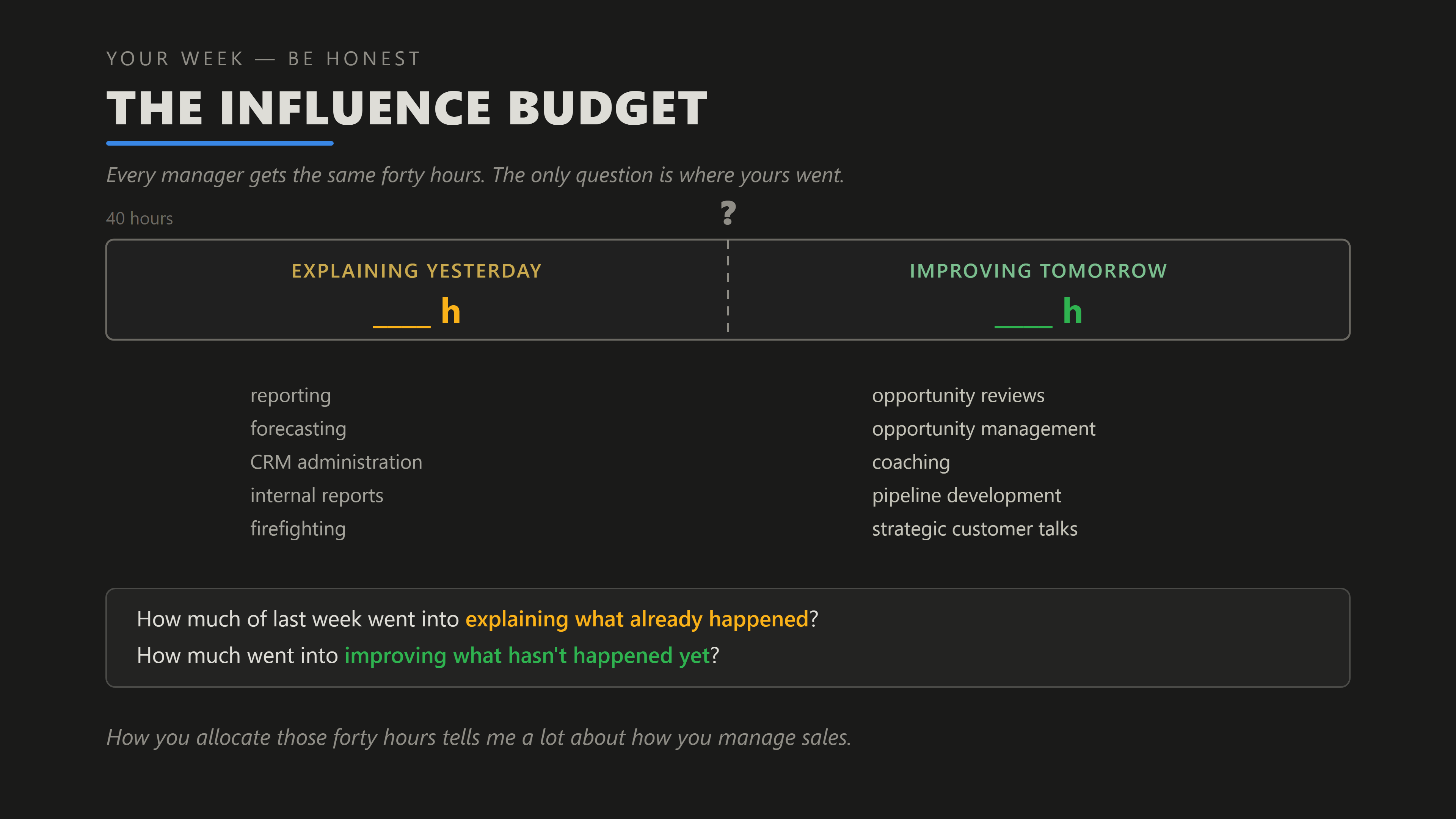
As a manager, what do you actually spend on the system? Not budget. Not headcount. Time. Every sales manager on earth gets the same resource: roughly forty hours a week. I call that your management influence budget.
Now split those hours into two kinds of work. Some of it explains yesterday: revenue reporting, CRM administration, internal reports, firefighting. The rest improves tomorrow: opportunity reviews, opportunity management, coaching, pipeline development, strategic customer conversations, better qualification. Both are real work. Both are necessary.
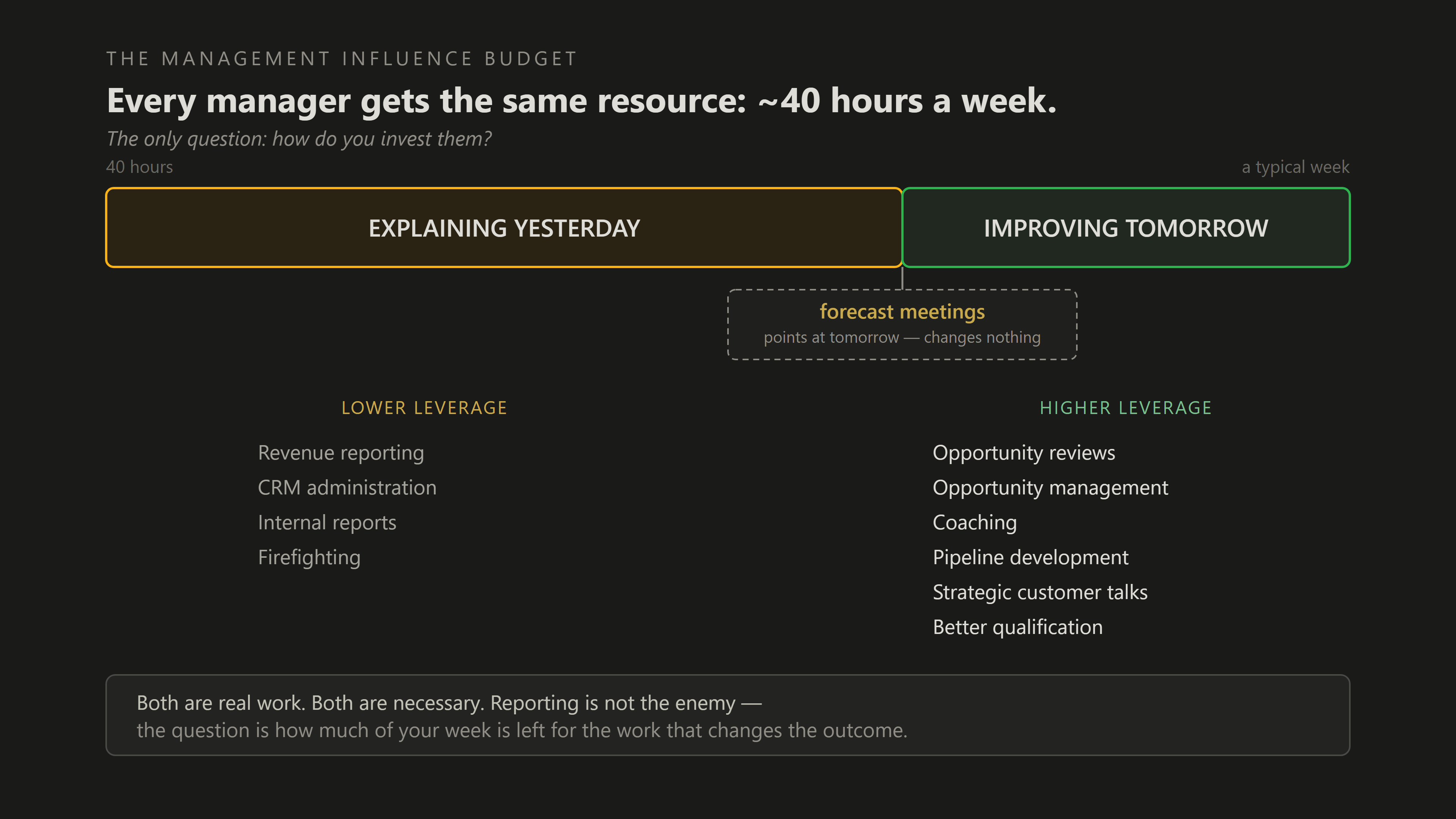
Forecasting deserves a footnote. It points at tomorrow. But a forecast does not change tomorrow. It describes a tomorrow you have not influenced yet. Explaining the past and predicting the future are the same kind of work. Both describe the business. Neither moves it.
Reporting is not useless. You need it. A manager who cannot explain the numbers is not a credible manager. This is not an argument against reporting. It is an argument about balance.
The question is not if you should do reporting. It’s how much of your week is left for the work that changes the outcome.
Model 2Circle of concern and circle of influence
There is an older idea behind this, from Stephen Covey, and it maps onto sales management almost perfectly. Covey separates two circles.
The circle of concern holds everything you care about but cannot control. Revenue. Bookings. Market conditions. Competitors. Exchange rates. Supplier situation and delivery times. Funding programmes. Geopolitics. Economic policy. GDP. Elections. New regulation. That list keeps growing every single year.
The circle of influence holds what you can actually change: the quality of your opportunities, how your people are coached, how deals get qualified, how your pipeline is built, how your team behaves in front of customers. That list is much shorter. And unlike the other one, it has not grown in years.
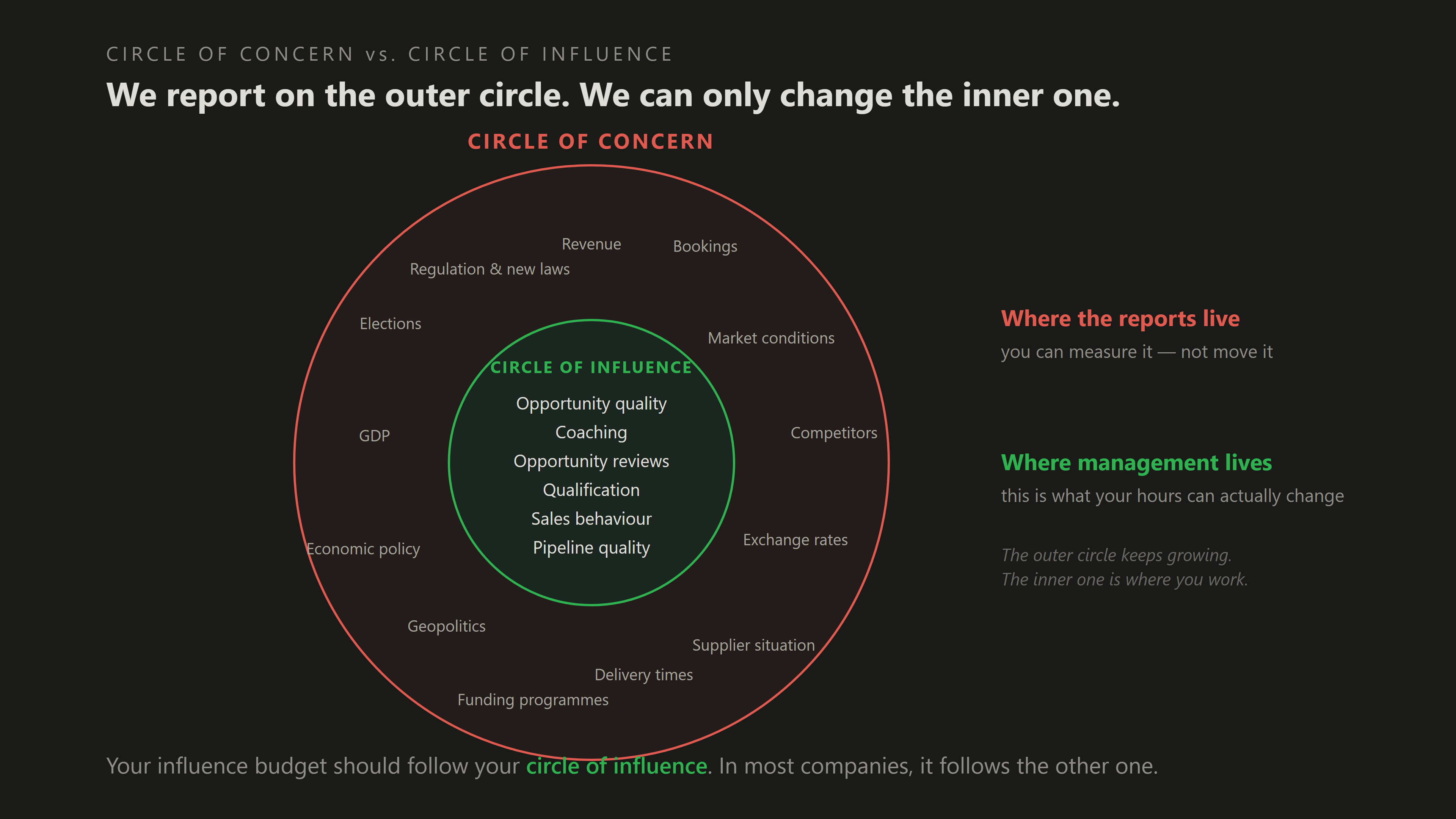
Almost everything we report on sits in the outer circle. Almost everything we can change sits in the inner one. Your influence budget should follow your circle of influence. In most companies, it follows the circle of concern instead.
Where revenue comes from
Revenue was a booking. That booking was an opportunity. That opportunity was qualified, or it wasn’t. And before that, it was a lead somebody decided to take seriously. By the time revenue shows up in your report, every decision that created it was made months ago, by other people, in conversations you were not part of.
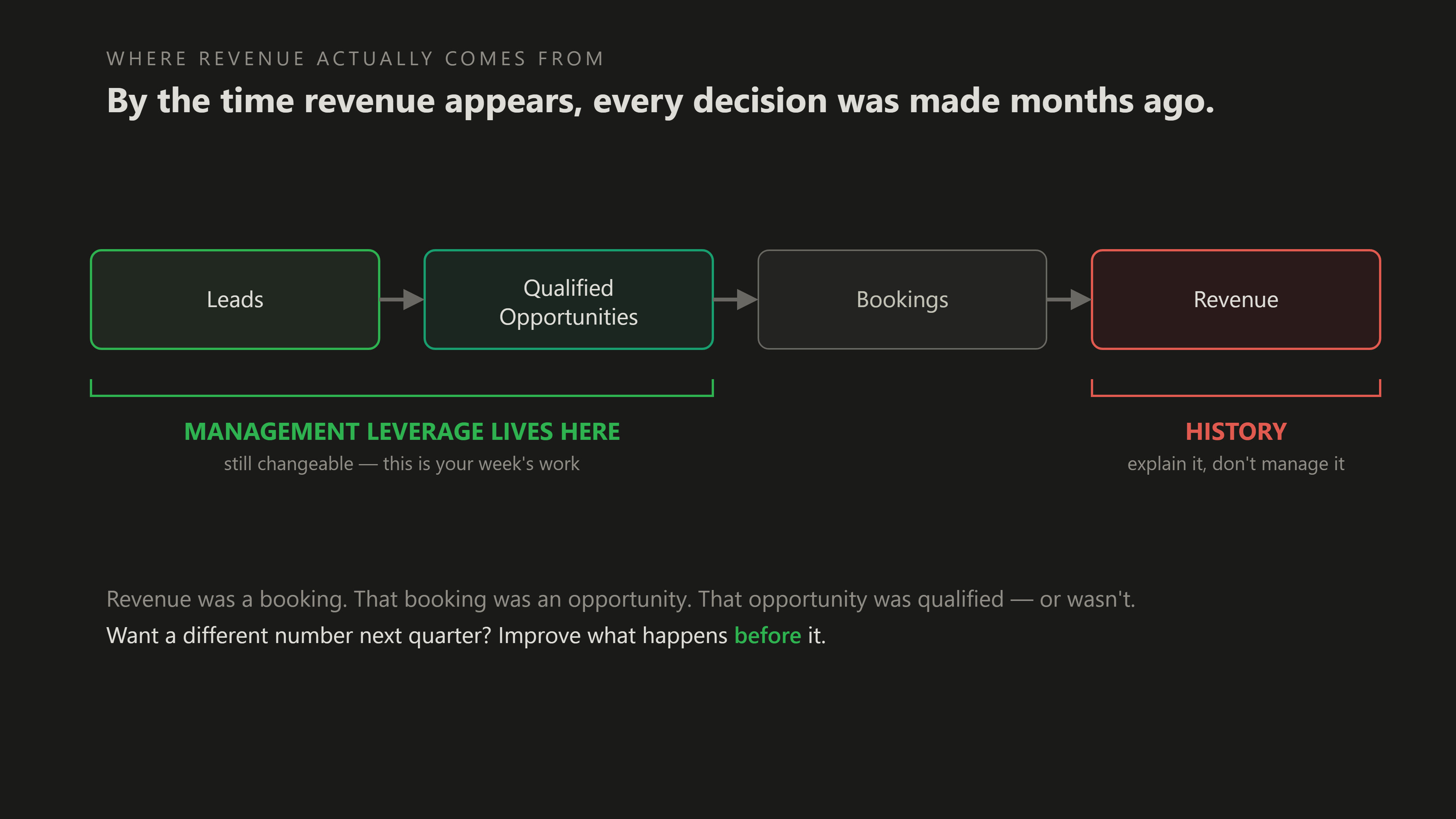
If you want a different result next quarter, you have to change something today. Discussing the revenue number will not change it. You have to work on the things that create it.
Conversion is an indicator, not a lever
Once you start changing the things that create revenue, you need a way to see whether you are actually getting better.
Conversion rate is not a lever. You cannot pull it. Nobody improves conversion by demanding better conversion. Conversion rate tells you whether the things you are changing are actually improving the system.
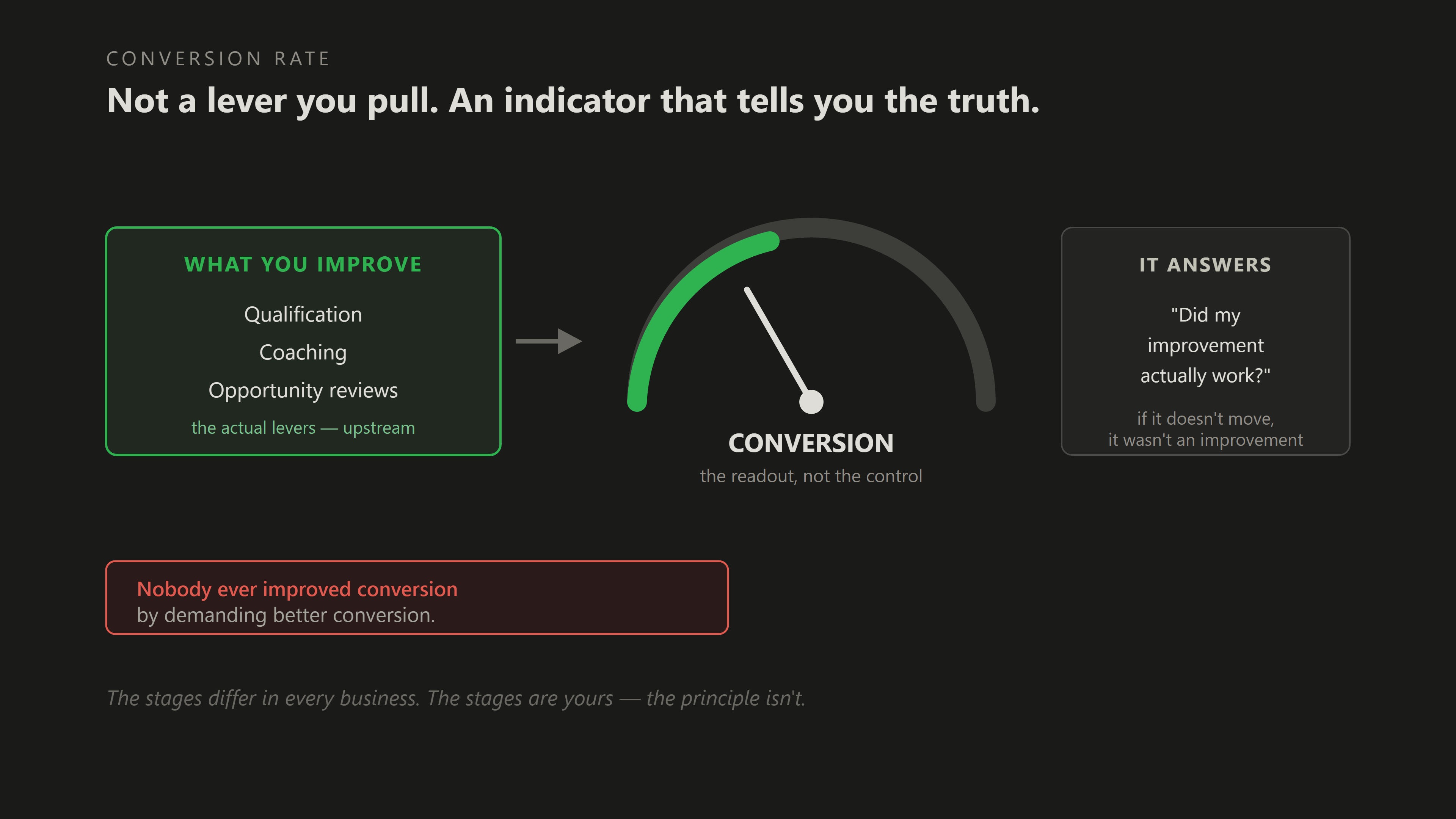
Better qualification. Better coaching. Better opportunity management. Those are the things you can work on. Over time, you should see the result in your conversion rate.
Don’t manage revenue. Manage what creates revenue. Don’t manage conversion. Manage what converts.
When does something become an opportunity?
I am deliberately not going to define the sales stages for you. Every business has a different sales process. But whatever stages you use, you need clear definitions. Otherwise your conversion rate tells you very little.
In most CRMs, almost anything can become an opportunity. A good conversation. An interest. A quote request. A hope. Conversion is a ratio: conversions divided by opportunities. If nobody agrees what belongs in the denominator, the ratio does not mean anything. Whether you use BANT, MEDDICC or three questions of your own matters far less than whether everyone draws the line in the same place.
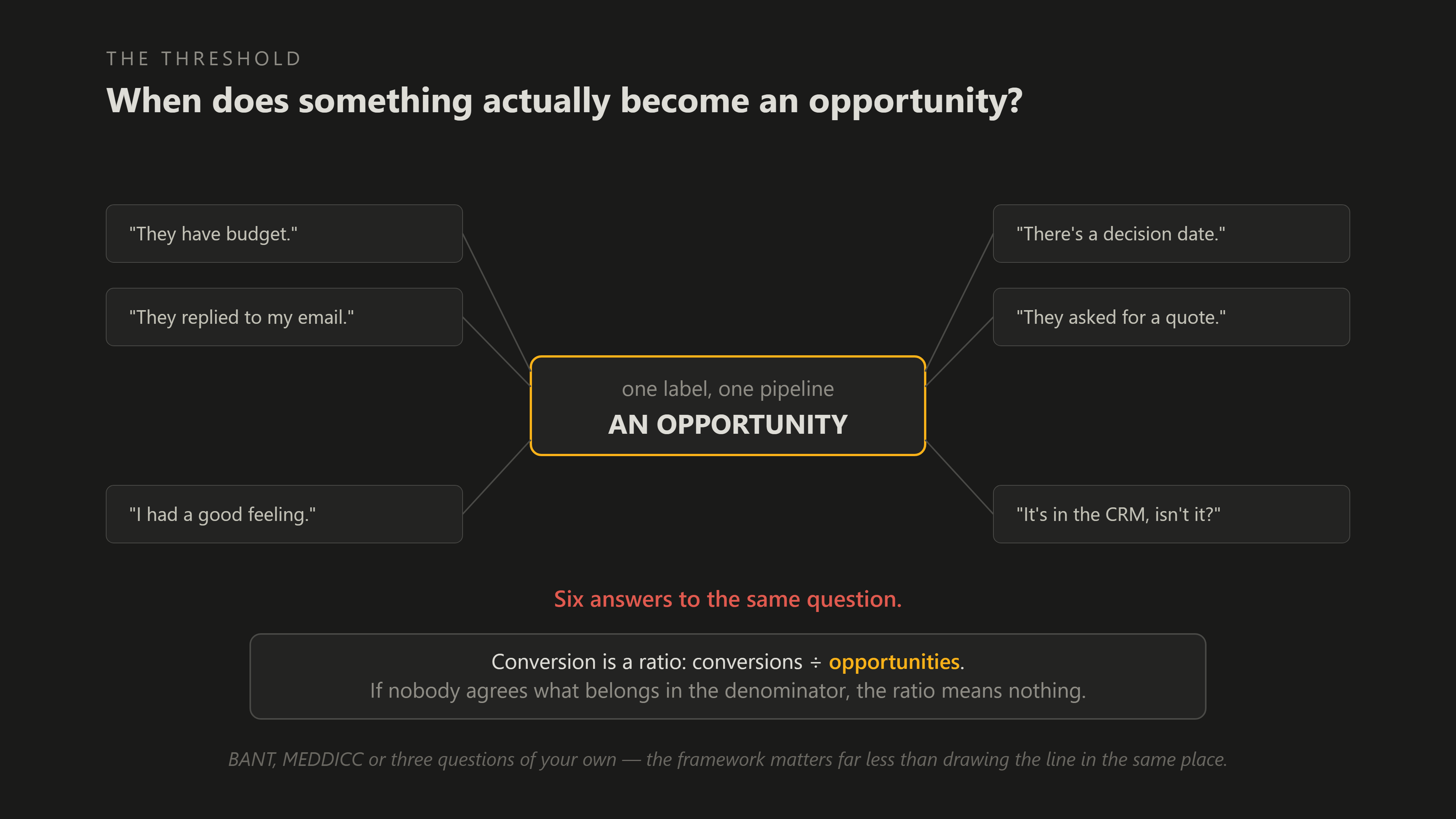
I have implemented opportunity management several times, and one thing has always been critical: a shared definition. Without it, your pipeline becomes a collection of private opinions. Your conversion rate becomes difficult to interpret. And your forecast discussions quickly turn into debates about definitions instead of discussions about the business.
Four things that move an opportunity
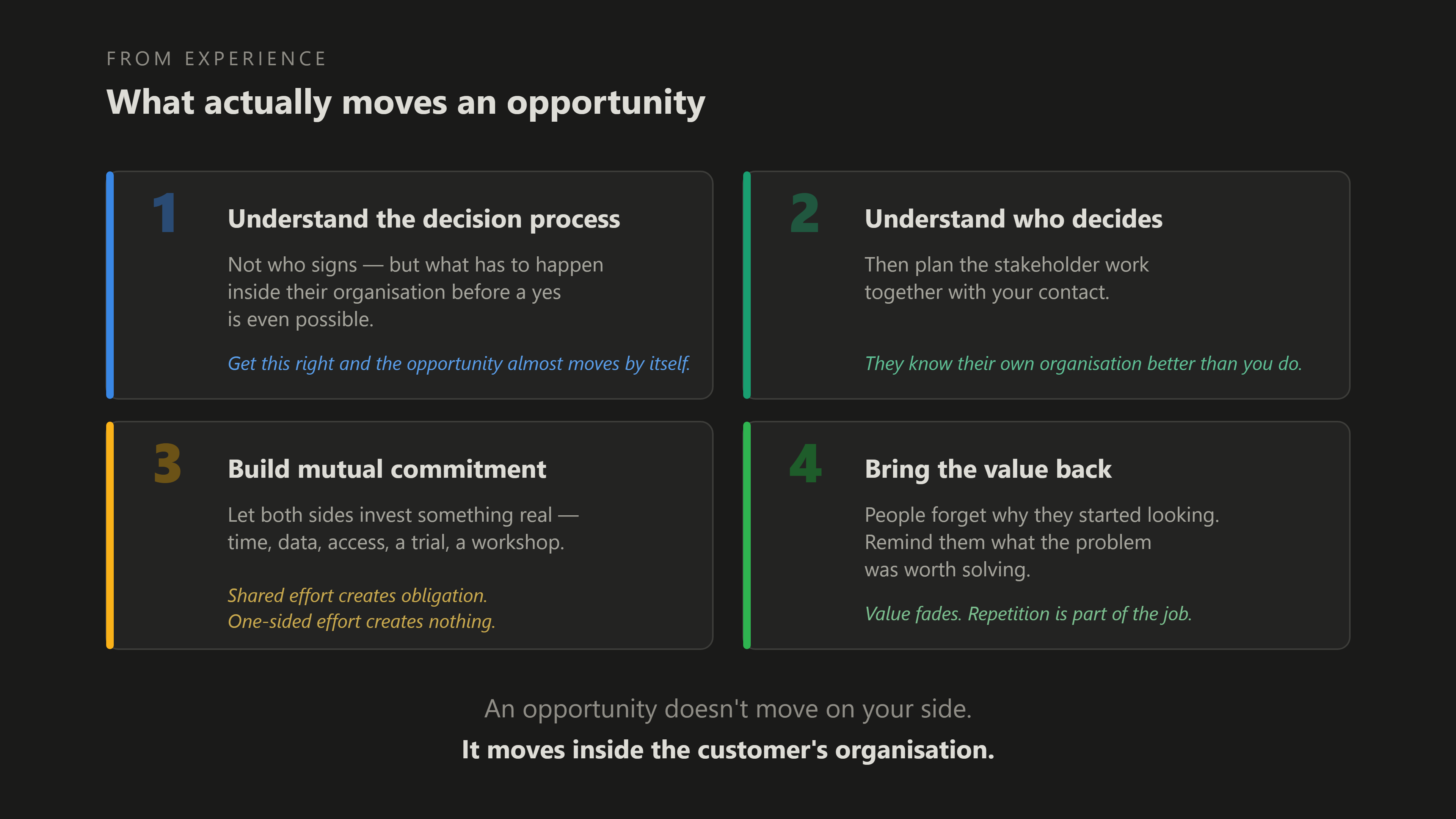
None of this is a framework. These are the four things that, in my experience, actually move an opportunity forward. None of them happen on your side.
- Understand how the decision is actually made. Not who signs, but what has to happen inside their organisation before a yes is even possible. Get that right, and the opportunity almost moves by itself.
- Understand who really decides. Then sit down with your contact and plan the stakeholder work together. They know their own organisation far better than you ever will.
- Build mutual commitment. Let both sides invest something real: time, data, access, a trial, a workshop. Shared effort creates obligation. One-sided effort creates nothing.
- Bring the value back. People forget why they started looking in the first place. Part of the job is reminding them what the problem was worth solving.
The coaching mistake
I have seen this in almost every sales organisation: trying to standardise successful behaviour.
It usually starts with a reasonable idea. You look at your best salesperson and ask: what does she do differently? Then you find something measurable. Let’s say she does a lot of demonstrations. So you conclude: our best salesperson does more demos, let’s get everyone to do more demos. It becomes a target. It goes into the CRM. And suddenly everyone is measured against it.
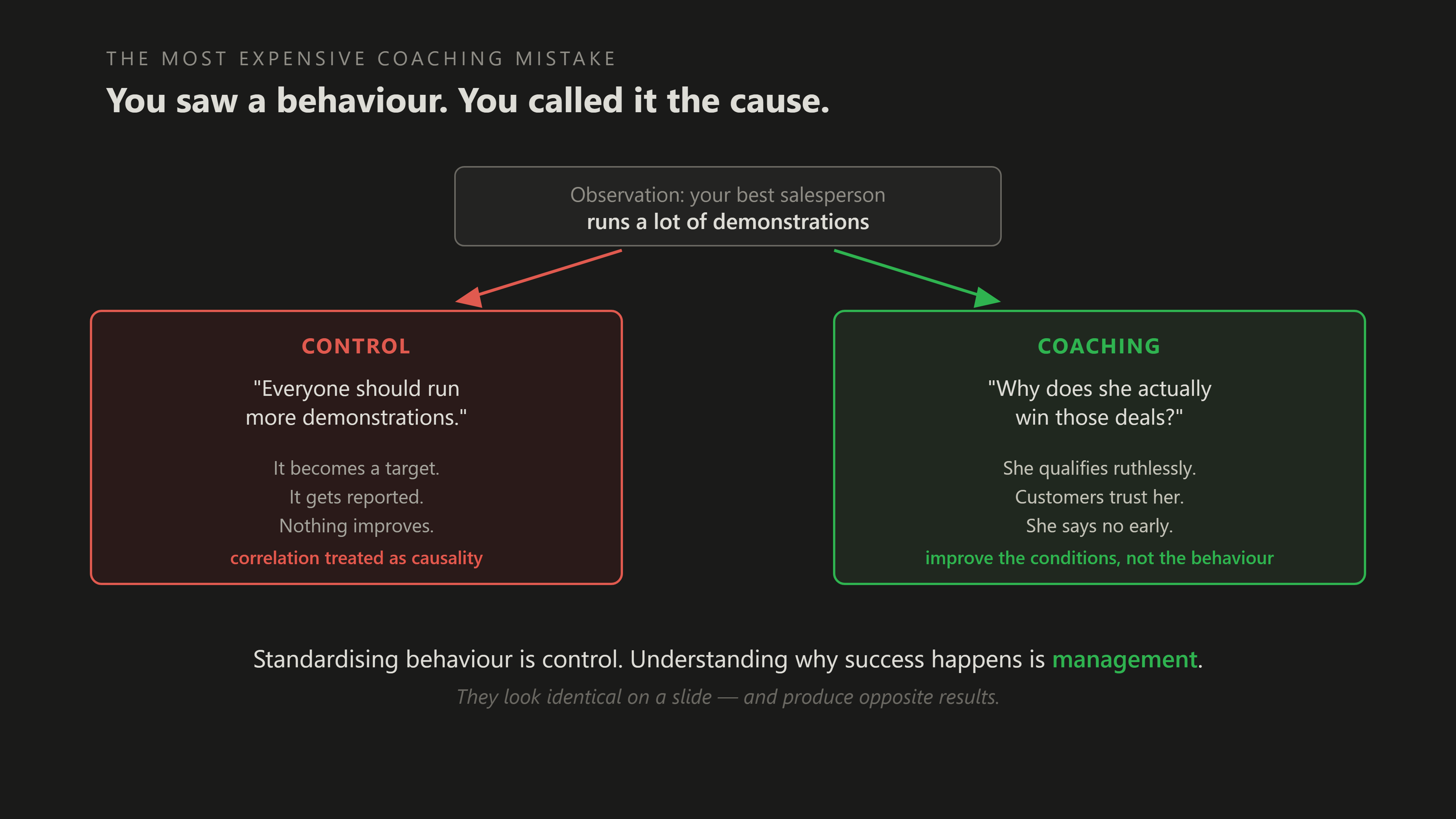
You know that your best salesperson does more demos. You do not know whether she is successful because she does more demos. That is a completely different question. Maybe the demos really are part of the reason. Or maybe she gets more demos because she qualifies better. Maybe customers trust her more. Maybe she walks away from bad opportunities while others spend months chasing them.
Copying the behaviour of your best salesperson is not coaching. You observed a correlation. You still haven’t understood the cause.
The job of sales management is not to make everyone sell the same way. If someone is successful, understand what is working, and be very careful before you change it. If someone is struggling, understand where the problem is, and coach there. Don’t change what works just to create a standard. Change what doesn’t work.
What AI changes
Think again about the forty-hour influence budget. Reporting. Preparing forecasts. Summarising meetings. Analysing CRM data. AI can already take a significant amount of that work away from us. That means something much more valuable than better reports. It gives management time back.
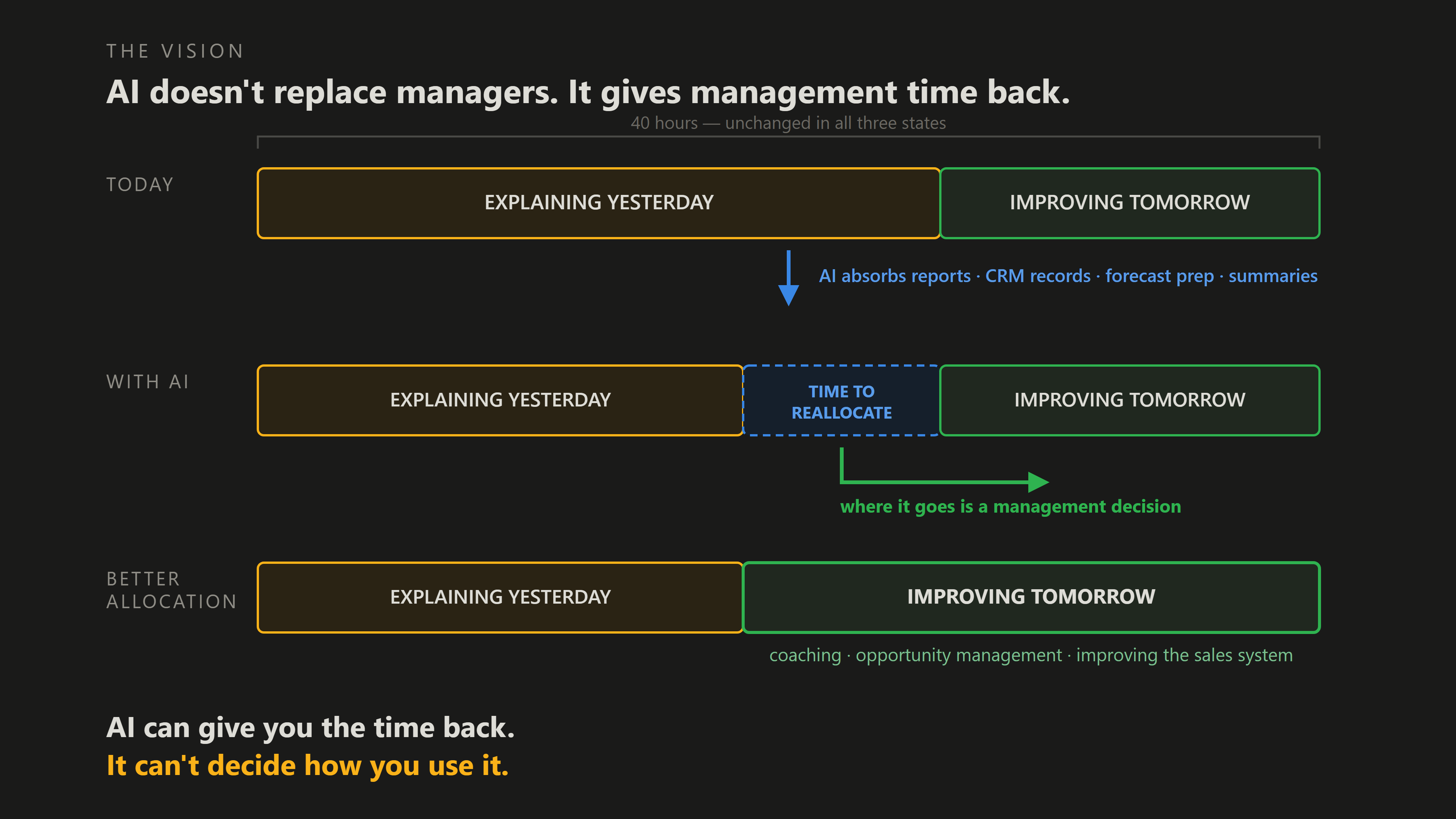
AI doesn’t manage your team. But it can give you more time to actually manage.
So imagine AI gives you five hours back every week. What do you do with them? More internal meetings? More reporting? Or do you invest them in opportunity management, coaching and improving the business? AI can give you the time back. It cannot decide how you use it. That is still management.
Your own week
Now look at your own week. You have roughly forty hours of management time. How much of that time goes into reporting, forecasting and administration? And how much goes into opportunities, coaching and actually improving the business? That is your influence budget. How you allocate those forty hours tells me a lot about how you manage sales.
Reporting is necessary, but reporting is not management. Revenue sits in your circle of concern. Opportunities, qualification and coaching sit in your circle of influence. Conversion tells you whether your work in that inner circle is real. And every hour you spend is a vote for one circle or the other.
The German word of this episode
Beschäftigungstherapie “occupational therapy”
Activity that keeps you busy without moving anything forward.
Terms on this page
- Management influence budget
- The roughly forty hours a week every sales manager gets, split between work that explains yesterday and work that improves tomorrow.
- Circle of concern
- Everything you care about but cannot control, such as revenue, bookings, market conditions and competitors.
- Circle of influence
- What you can actually change: the quality of your opportunities, how your people are coached, how deals get qualified and how your pipeline is built.
- Conversion rate
- Conversions divided by opportunities. It is not a lever but an indicator of whether the things you are changing are actually improving the system.
- Shared definition
- One answer to the question of when something becomes an opportunity, so that everyone draws the line in the same place.
Source. Stephen Covey: Circle of Concern vs. Circle of Influence.