


The short answer
Segmentation is a model of reality. It is not reality itself.
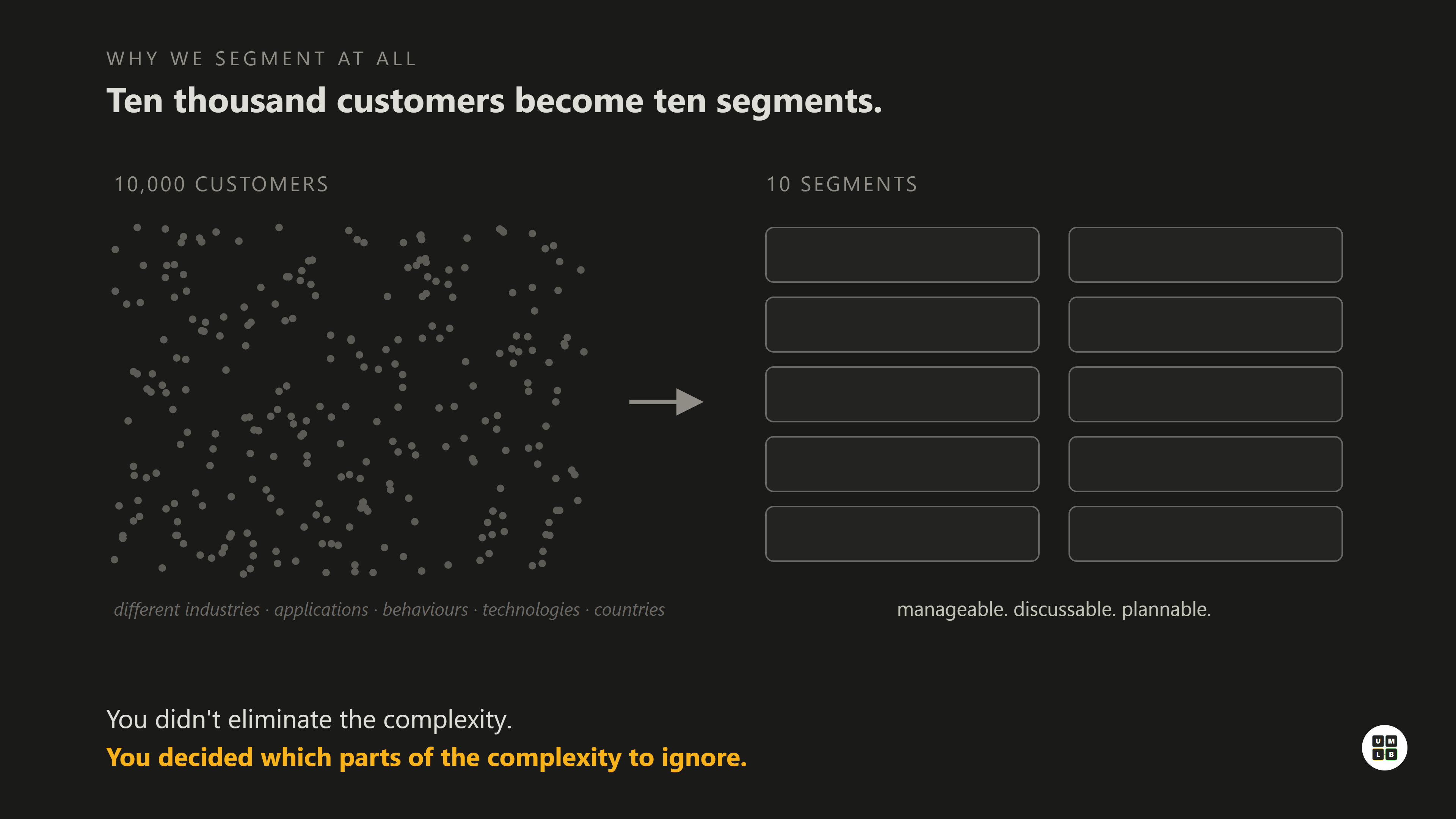
When you sort ten thousand customers into ten segments, you do not remove the complexity. You decide which parts of it to ignore. From then on, decisions are made on the model, and the parts you ignored are no longer visible. Most segmentation mistakes start there.
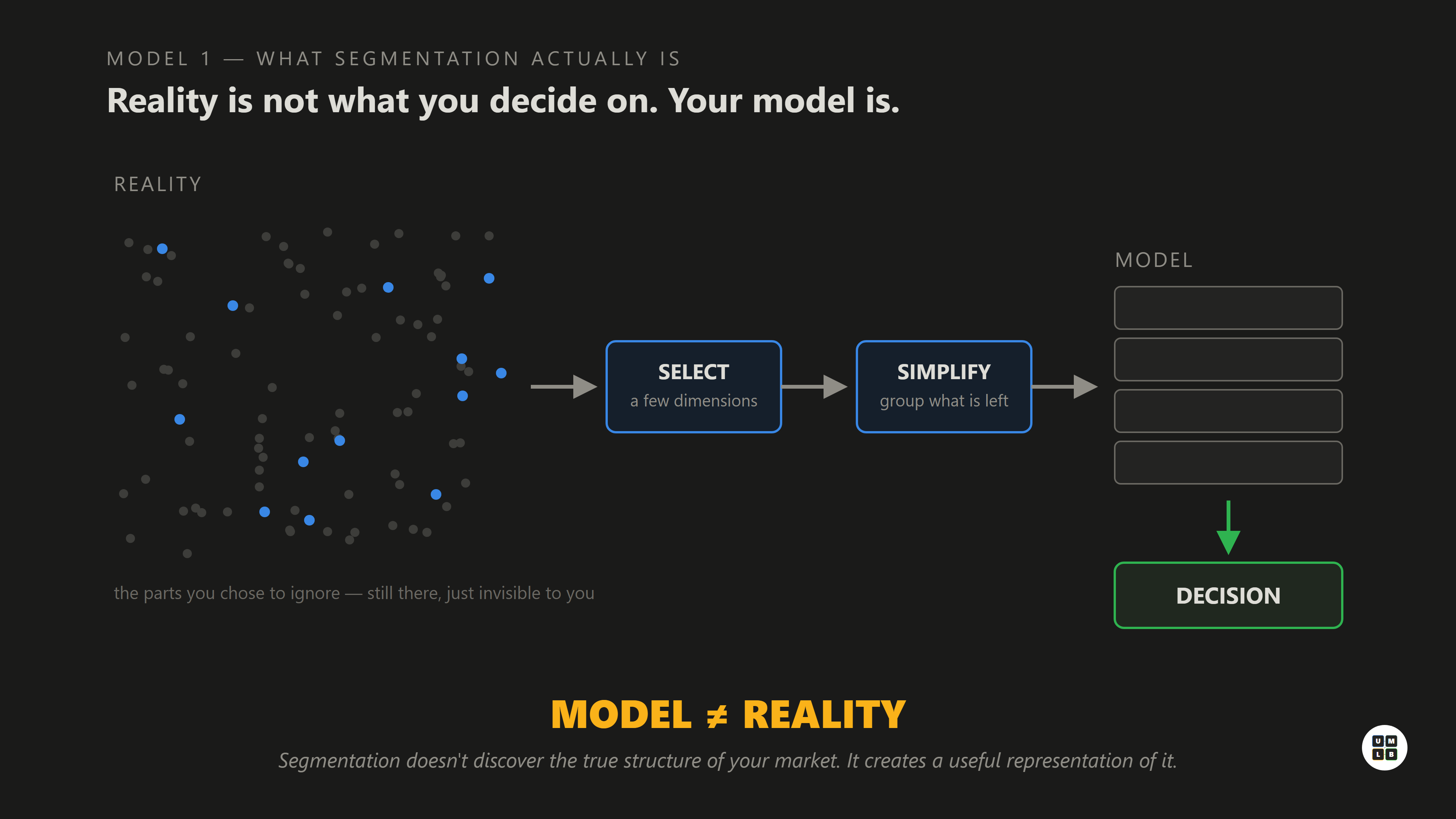
Model 1Reality → Model → Decision
Reality holds more complexity than anyone can process. Segmentation selects a few dimensions out of it. That selection produces a simplified model, and management then makes decisions on that model, not on reality.
Segmentation does not discover the one true structure of your market. It creates a useful representation of it. Useful is not the same as true. Keep those two apart, and half the mistakes in this field disappear.
The idea is old. The term entered marketing in 1956, in a paper by Wendell R. Smith. He did not present segmentation as a picture of the market. He presented it as a strategy, one of two things a company could choose to do. It was a decision from the start.
Why a good model fails when you copy it
In a medical business, segmentation and targeting worked very well. Hospitals are identifiable. You know where they are and which departments they have. You can estimate the expected equipment need, and you often know the installed base. So you can calculate a share of wallet and ask the most useful question in that business: why is this hospital buying less from us than a comparable one?
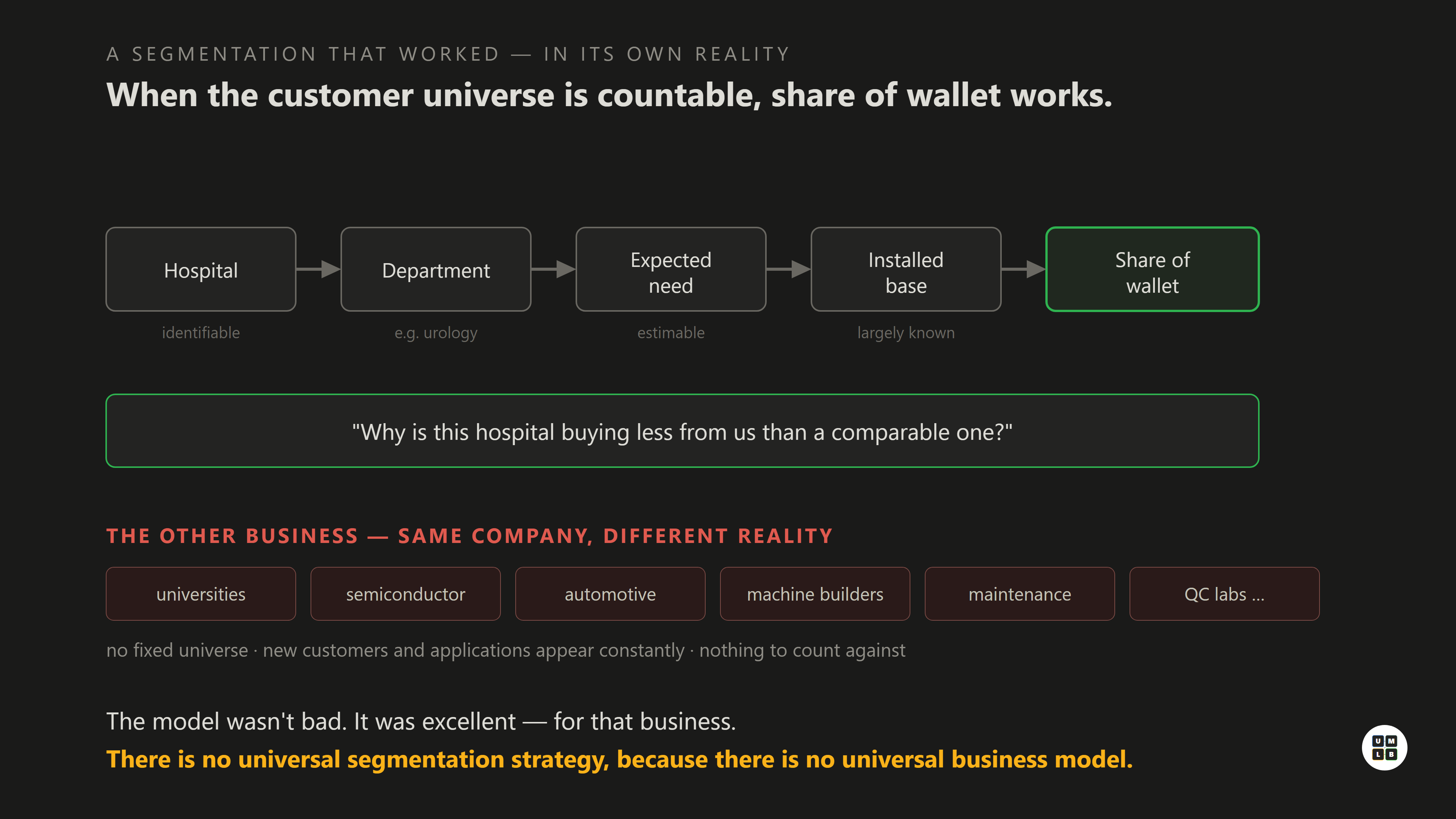
A scientific instruments business looked at that and concluded: we need this too. But its reality was different. A potential customer could be a university, a semiconductor manufacturer, an automotive company, a machine builder, a maintenance department or a quality-control lab. New customers and new applications appeared constantly. There was no fixed universe to count.
The medical model was excellent. The mistake was copying a model built on completely different assumptions into a different business reality.
There is no universal segmentation strategy, because there is no universal business model.
Model 2The segmentation lens
If segmentation selects dimensions, which ones are the right ones? Think of them as lenses. The same customers can be viewed through industry, application, manufacturing process, region, buying behaviour, commercial model, strategic importance or function.
Each lens produces a different and perfectly legitimate segmentation of the same customers. Every lens reveals something and hides something else.
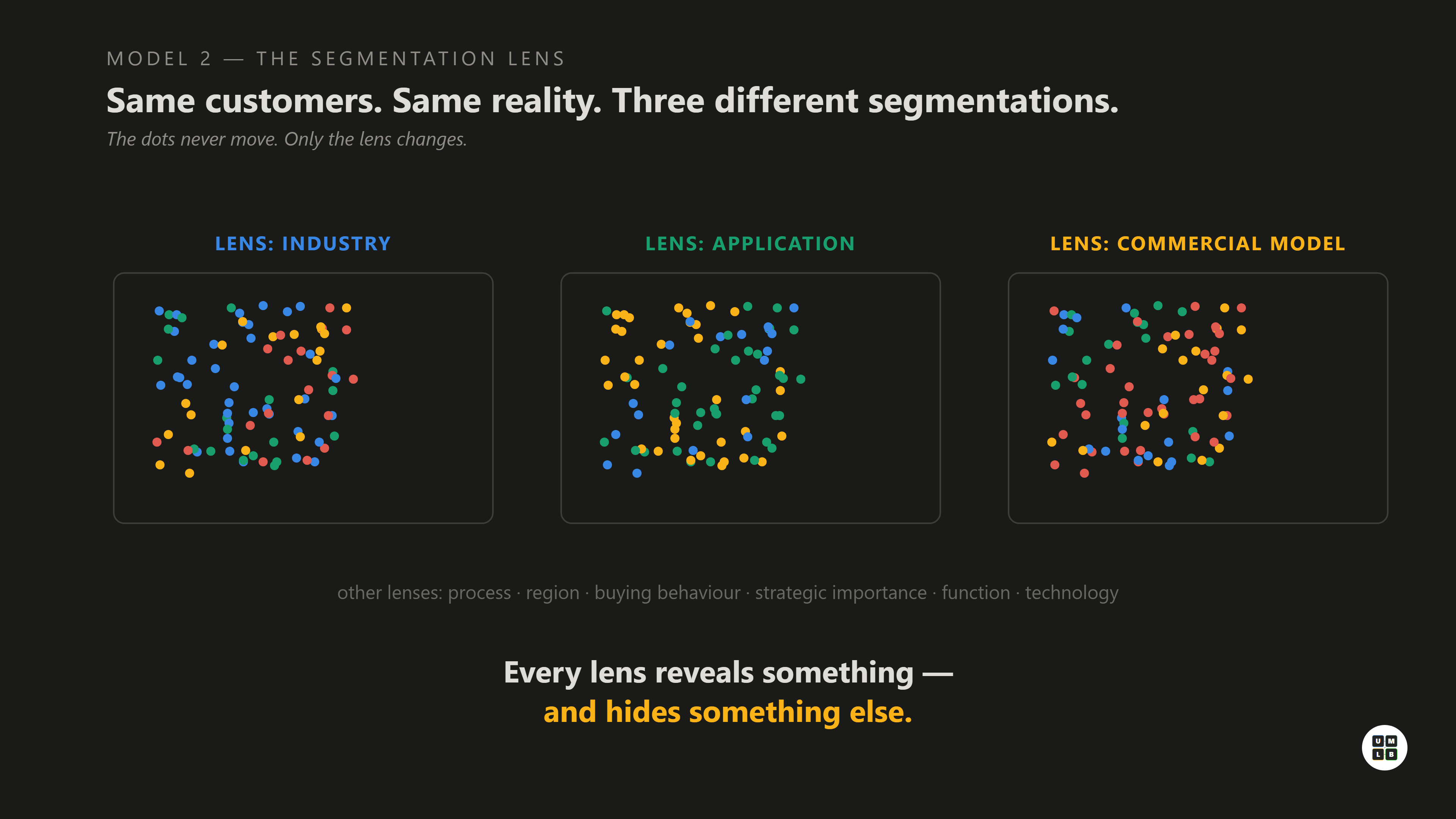
A customer does not belong to a segment by nature. We place them in one because that perspective helps us answer a question. In the same moment, we decide which parts of that customer we are going to ignore.
Correlation is not yet segmentation
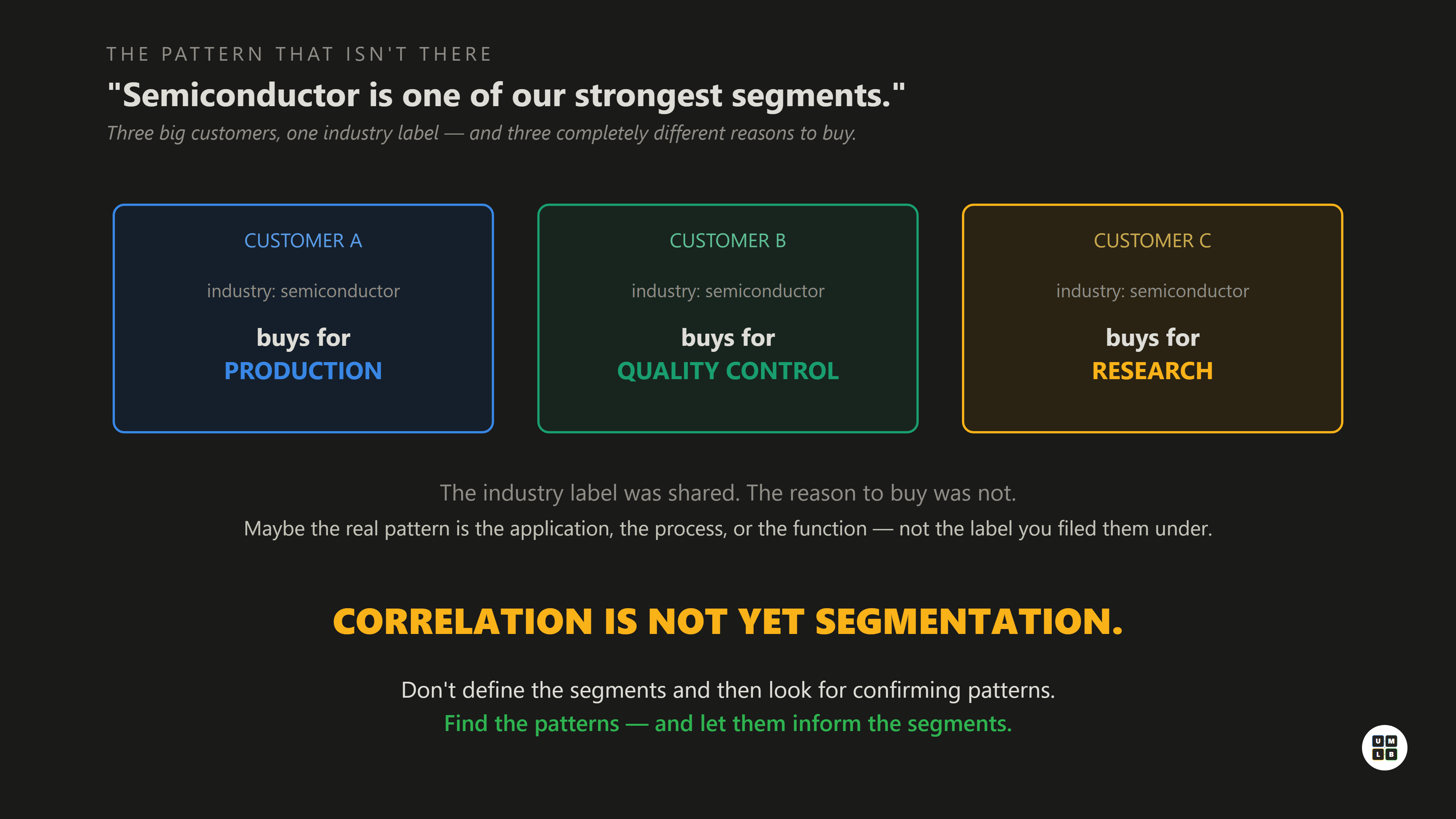
Imagine three of your largest customers are semiconductor manufacturers. The conclusion writes itself: semiconductor is one of our strongest segments.
Then you ask why they buy. Customer A buys for production. Customer B for quality control. Customer C for research. In that case the industry does not explain the buying behaviour at all. What they share might be the application, the process or the function, and not the label you filed them under.
What a wrong lens costs
Automotive looks clean on a slide: OEM, tier one, tier two. Reality is messier. Many suppliers serve automotive, machine building, aerospace and electronics at the same time. File them all under automotive, and your data says that automotive is one of your strongest markets.
That classification becomes a strategic target. The target directs marketing investment. Marketing collects voice of customer in that segment. Those inputs become product requirements. Requirements become R&D investment.
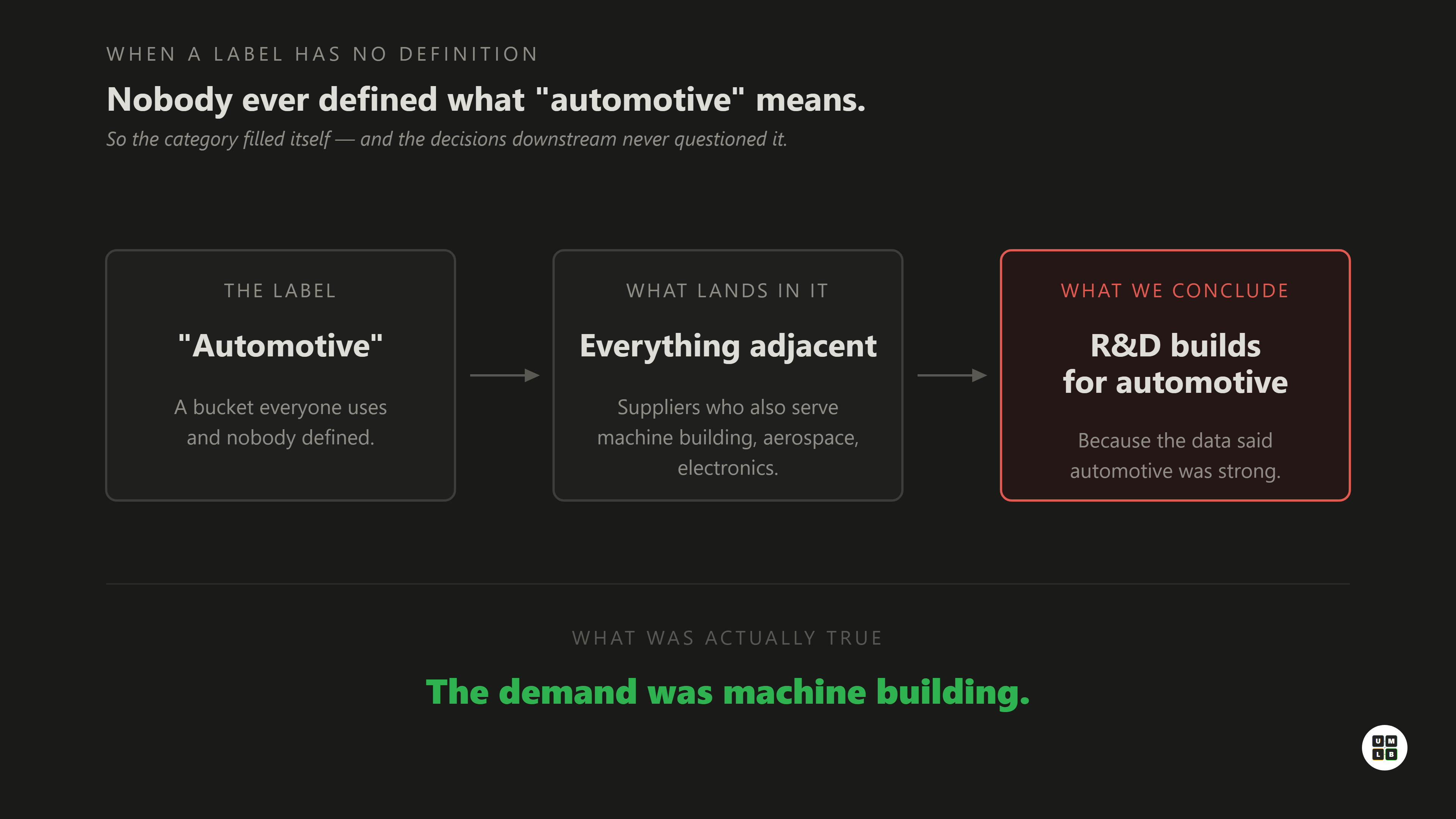
The further a segmentation assumption travels through an organisation, the more expensive it becomes when that assumption is wrong.
The invisible segment
Picture a global niche technology company and look at its market through geography. Germany is large. France is large. Then come Slovakia, Slovenia, Croatia, Serbia and Albania, each one small. Individually, every one of them looks unattractive. The strategy writes itself: focus on the large markets and de-invest from the small ones. That is reasonable and defensible. It may also be wrong.
Now change the lens and segment by commercial model. Those countries are no longer a collection of small markets. They are one segment: long-tail distributor markets, with low individual revenue, low management attention and a highly scalable commercial model. Collectively they might be twenty percent of revenue, run on essentially one system.
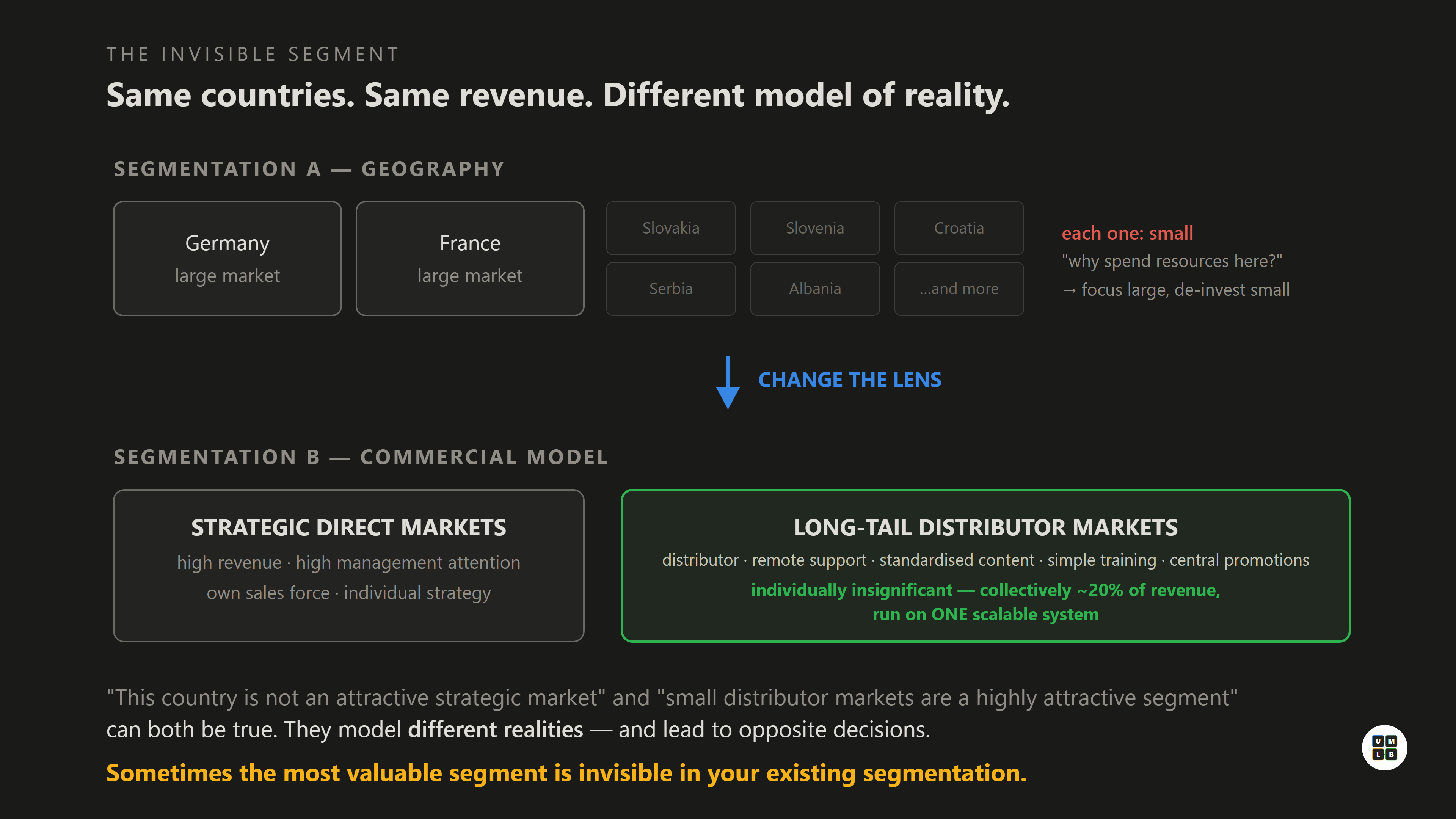
Sometimes the most valuable segment is invisible in your existing segmentation.
Segmentation drift
Once a segmentation is implemented, it hardens. Categories become CRM fields. Processes, dashboards and reports are built on them. New employees inherit them. Meanwhile markets, customers, applications and your own strategy change. The segmentation stays, because changing it is work and coordination and nobody’s project.
A second thing happens quietly. New colleagues classify new customers without knowing the assumptions behind the original categories. Interpretations drift apart, and small classification errors compound for years. Eventually you have a segmentation that still looks perfectly structured while the reality underneath has moved somewhere else.
The discipline against it is to document the assumptions and not only the outcome. For every segment: why does this category exist, which question was it built to answer, which assumptions created it, and what does it deliberately ignore?
What AI changes
For a long time the compression was not a choice. Understanding thirty thousand customers in real depth was not possible, so we simplified and lived with the cost. That constraint is what changed. The interesting claim is not that AI does your segmentation. Three limitations shift.
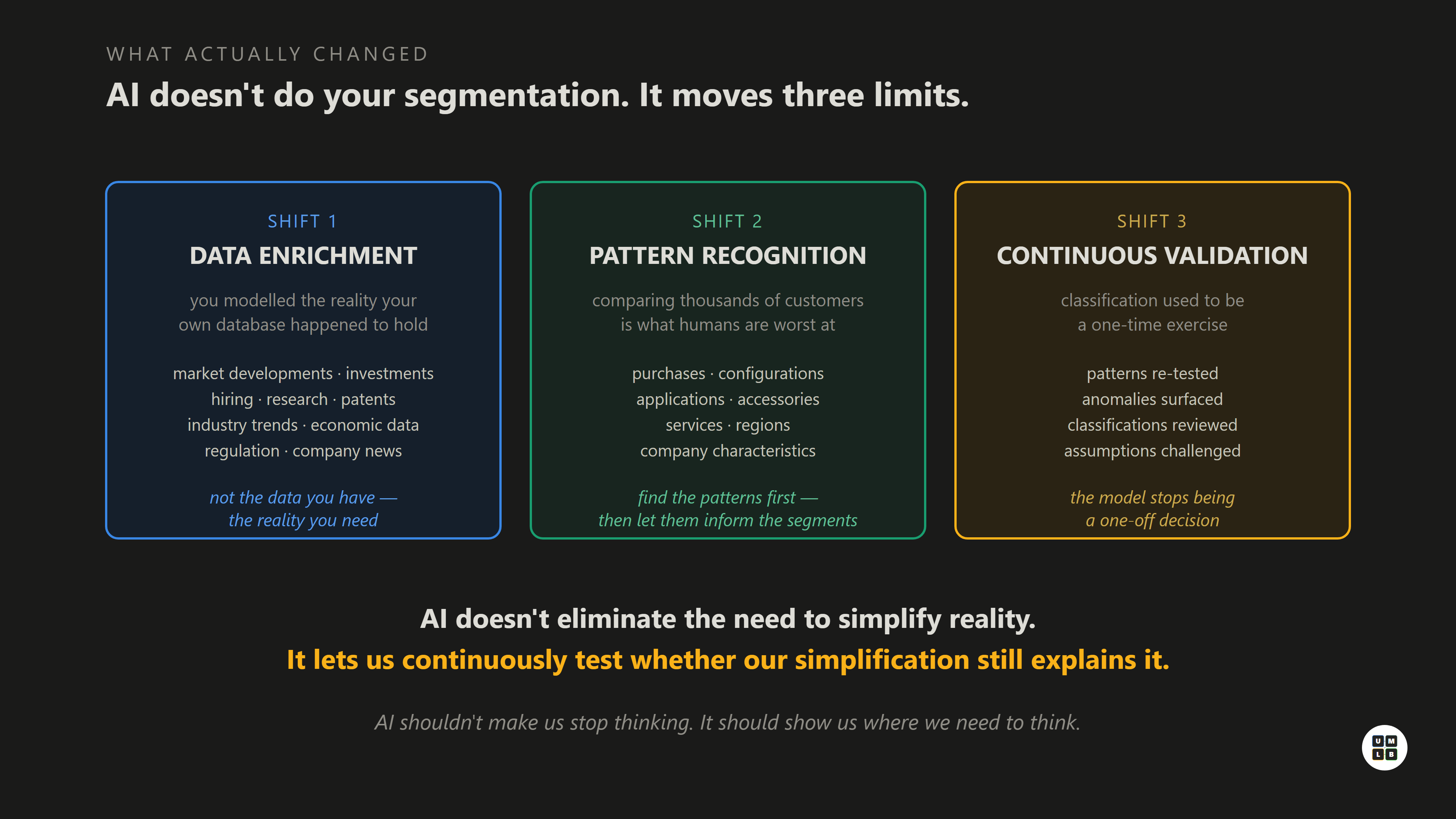
AI doesn’t eliminate the need to simplify reality. It allows us to continuously test whether our simplification still explains reality.
Noise or signal
A major German automotive manufacturer once bought a fluorescence microscope. It looked so out of place that people wondered whether it was a booking error. It was not. They had a genuine and slightly exotic application: investigating microbial contamination in windshield washer fluid.
Maybe the customer isn’t wrong. Maybe your model is.
Seven things to check
No framework. A five-step model at this point would do exactly what this page argues against. This is what I would keep on a sheet of paper instead.
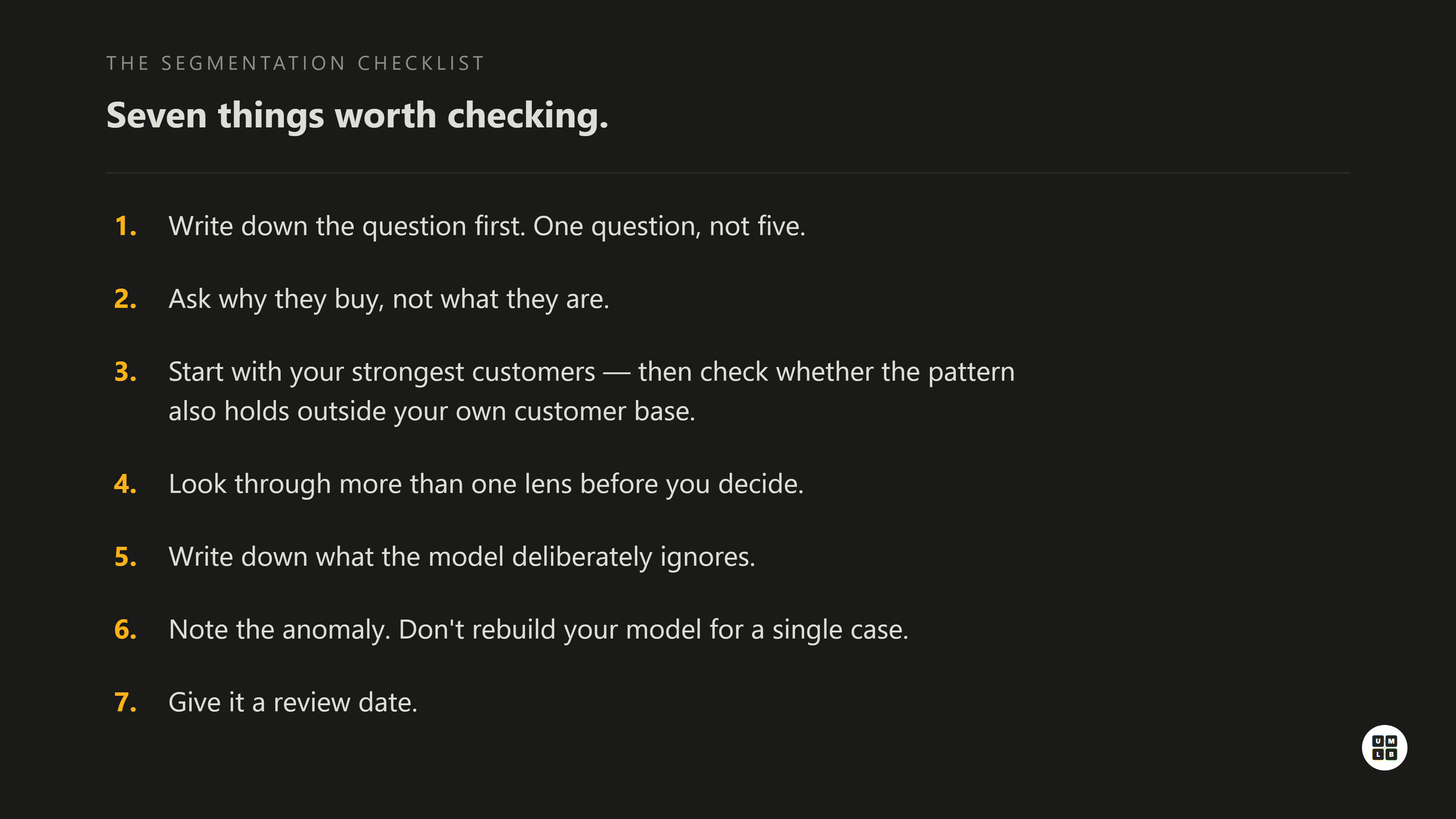
- Write down the question first. One question, not five.
- Ask why they buy, not what they are.
- Start with your strongest customers. Then check whether the pattern also holds outside your own customer base.
- Look through more than one lens before you decide.
- Write down what the model deliberately ignores.
- Note the anomaly, but don’t rebuild your segmentation for one microscope.
- Give it a review date.
Do not ask for the perfect segmentation. It does not exist. Your customers, your markets and your business will change, and your segmentation should be able to change with them.
The German word of this episode
Eierlegende Wollmilchsau “egg-laying, wool-producing, milk-giving pig”
One solution expected to do absolutely everything at once.
Terms on this page
- Segmentation
- A model of reality that groups many customers into a few segments you can decide on. It is a choice, not a discovery.
- Segmentation lens
- The dimension through which the same customers are grouped, such as industry, application or commercial model. Every lens reveals something and hides something else.
- Share of wallet
- The part of a customer's spend in a category that goes to you. It only works where the customer universe is fixed and countable.
- Segmentation drift
- The slow gap that opens when a segmentation stays fixed in systems and reports while markets, customers and strategy change.
- Long-tail distributor markets
- Many small markets that look unattractive one by one but form one scalable segment when grouped by commercial model.
Source. Smith, W. R. (1956). Product Differentiation and Market Segmentation as Alternative Marketing Strategies. Journal of Marketing.